
3,000+ Homes Mitigated Across Alberta and British Columbia · Guaranteed Results
Radon Mitigation and Testing in Edmonton
Edmonton and Calgary top the radon averages of Canada's six biggest metro areas. Across the Edmonton metro area, the 2024 Cross-Canada Survey of Radon found about 1 in 6 homes at or above Health Canada's guideline. Our crews fix radon in Edmonton homes of every age, from wartime bungalows in Parkdale to new townhouses in Heritage Valley. Got a number and not sure what to make of it? Call us.
Not tested yet? Start with a test kit →
Got a reading from a library radon detector? Call and talk to a radon expert about what it means for your home.
On this page: Our Results · Radon Levels · Testing · Building Code · FAQ · Free Quote

★★★★★ 4.9
280+ Google reviews

★★★★★ 4.9
on HomeStars


C-NRPP Certified

Consumer Choice Award winner, 2022 to 2026

Partner in radon research led by the University of Calgary

Radon partner in Alberta
Our Radon Mitigation Work in Edmonton
Just a Few of Our Results From the Area
Our job records for homes in and around Edmonton: where a lab tested the house again after we fixed it, about half of those results read below 30 Bq/m³, and about three quarters below 50.
Each system is designed for the house it goes in. Canada's national standard for radon mitigation (CAN/CGSB-149.12-2024, section 1) says a system that is properly designed and installed by certified professionals can lower radon by about 90% or more. How well a system works comes down to who designs and installs it. We've lowered the radon in every home and commercial building we've ever worked on. Every system we install comes with guaranteed results.
Tricky homes are the ones our technicians enjoy most. Even after more than 3,000 homes, we still run into something new now and then, and when we do, the whole team works on it together, so every job has the experience of all our crews across Alberta and BC behind it.
The Five Homes Below
Before Mitigation
252 to 450Bq/m³
After
<7 to <26Bq/m³
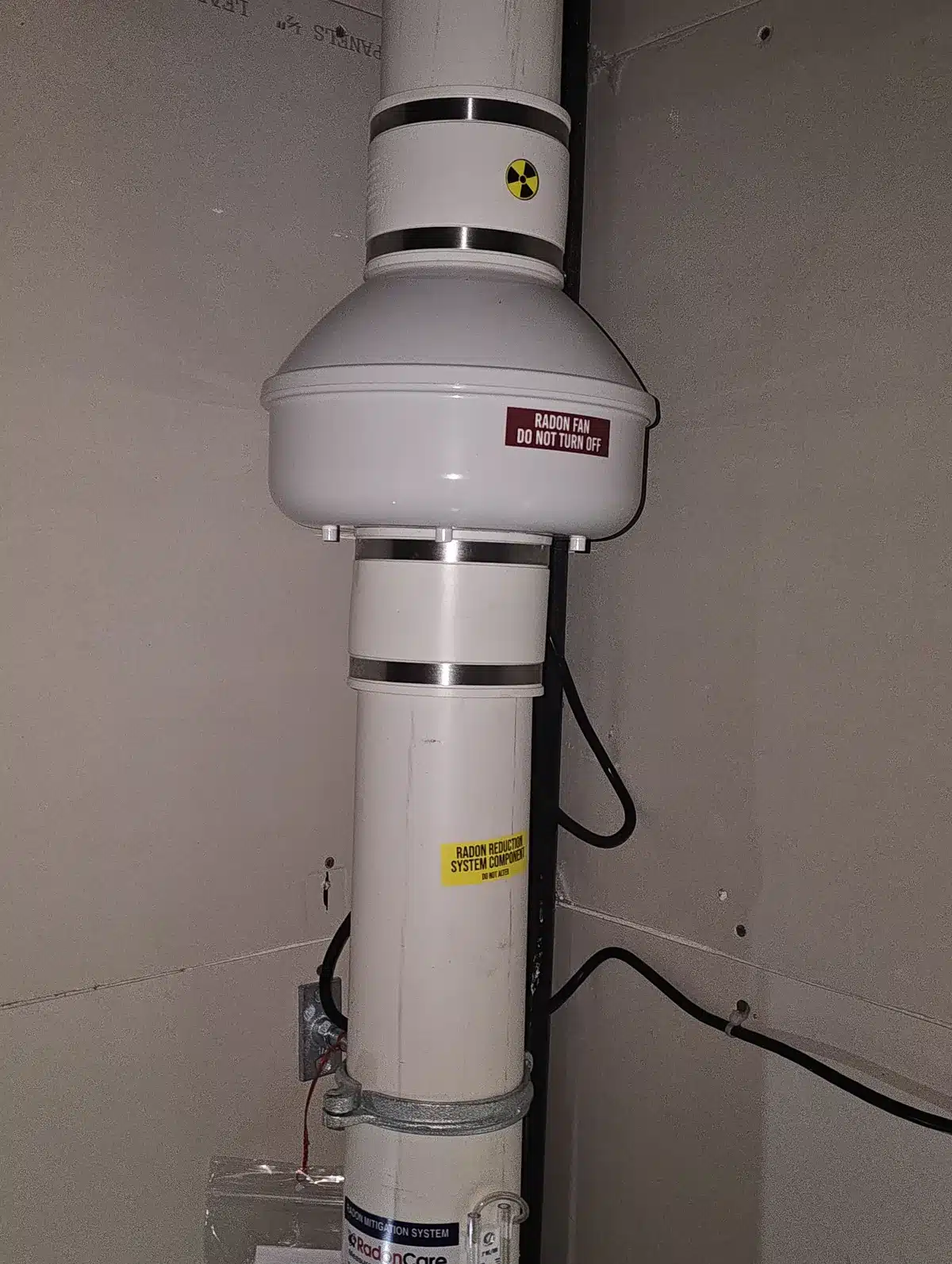
337→<7Bq/m³
Wartime bungalow, Parkdale area, north-central Edmonton
1940s · part-finished basement · no sump pit
Their first test, years ago, was low. Then they insulated the house, and the next test came back high. We added suction through the basement floor, and the lab test after came back under 7 Bq/m³.
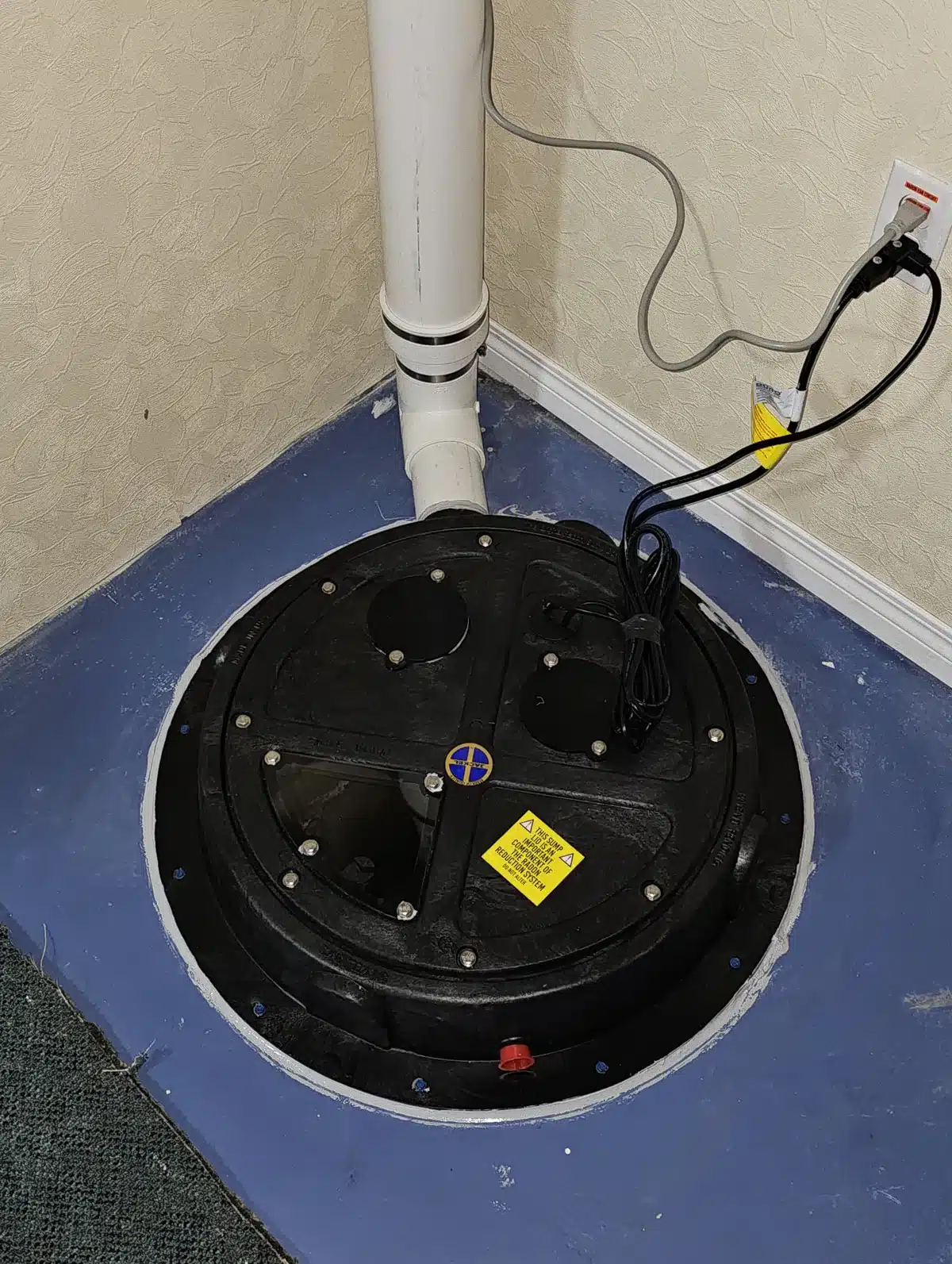
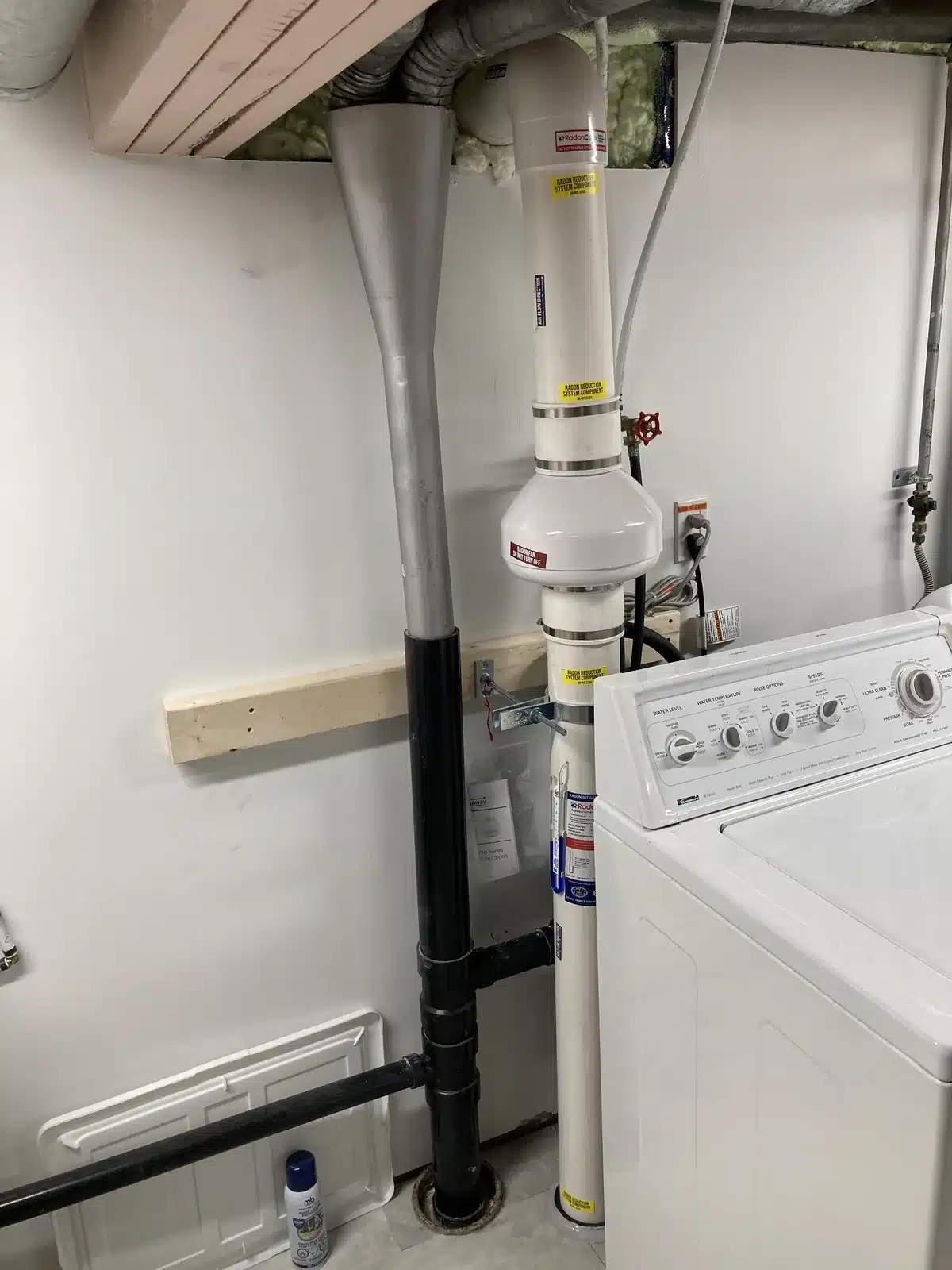
256→<15Bq/m³
Two-storey, Glastonbury area, west Edmonton
Early 2000s · finished basement · sump pit
The sump pit was full of sand. We cleaned it out, put in a new pump and sealed the lid, and a small fan was all it needed. Lab tests before and after.
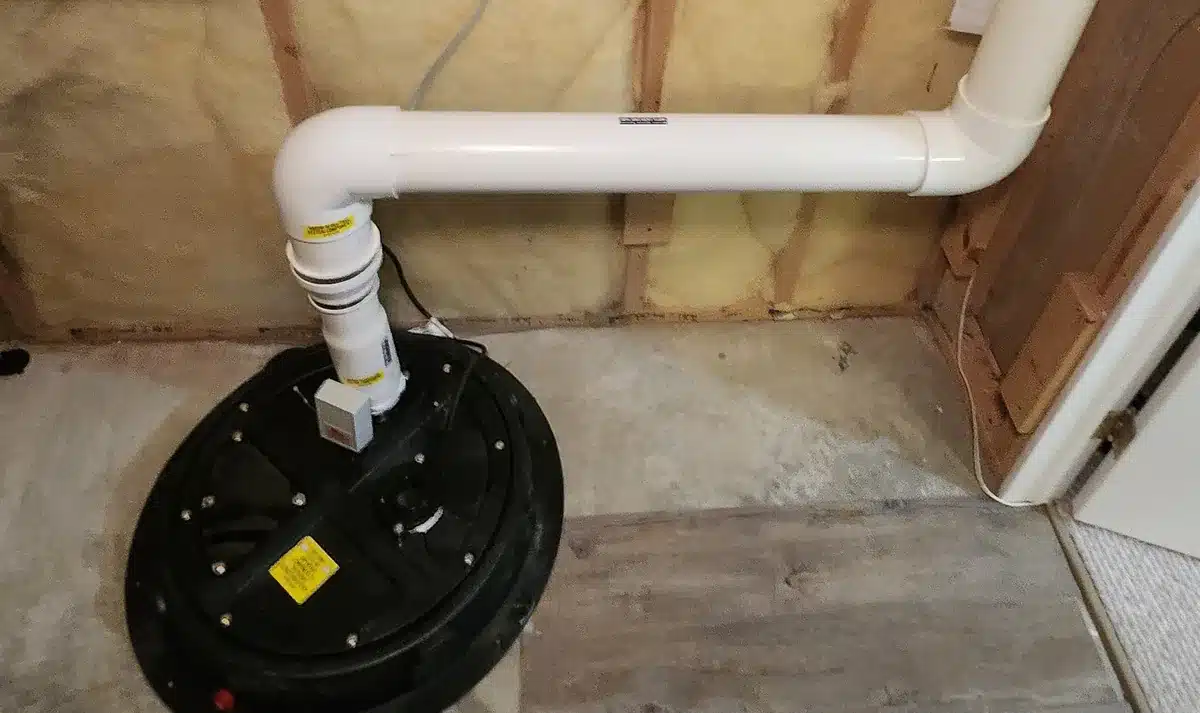
450→14Bq/m³
Newer house, Walker area, southwest Edmonton
Late 2010s · finished basement · builder's radon rough-in
Built with the capped radon pipe the code asks for, and an earlier long-term test still read 450. A capped pipe has no fan, so on its own it lowers nothing. With our system running, a lab test of about nine months read 14.
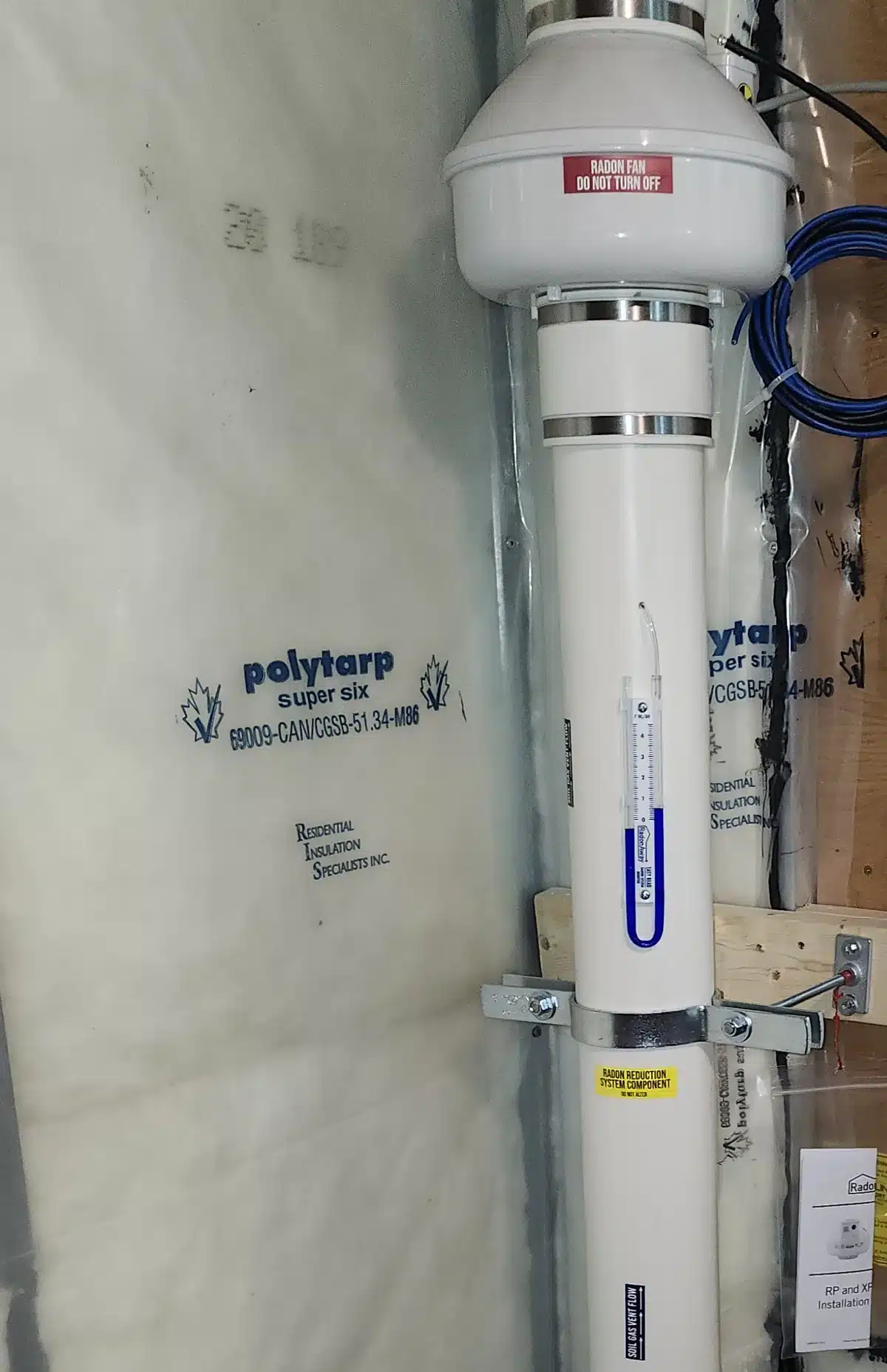
252→<26Bq/m³
Middle-unit townhouse, Heritage Valley area, southwest Edmonton
2020s · unfinished basement · sealed sump
A newer townhouse with a sump pit. We drew from the sealed sump with a small fan and sealed the floor edges. Lab tests before and after.
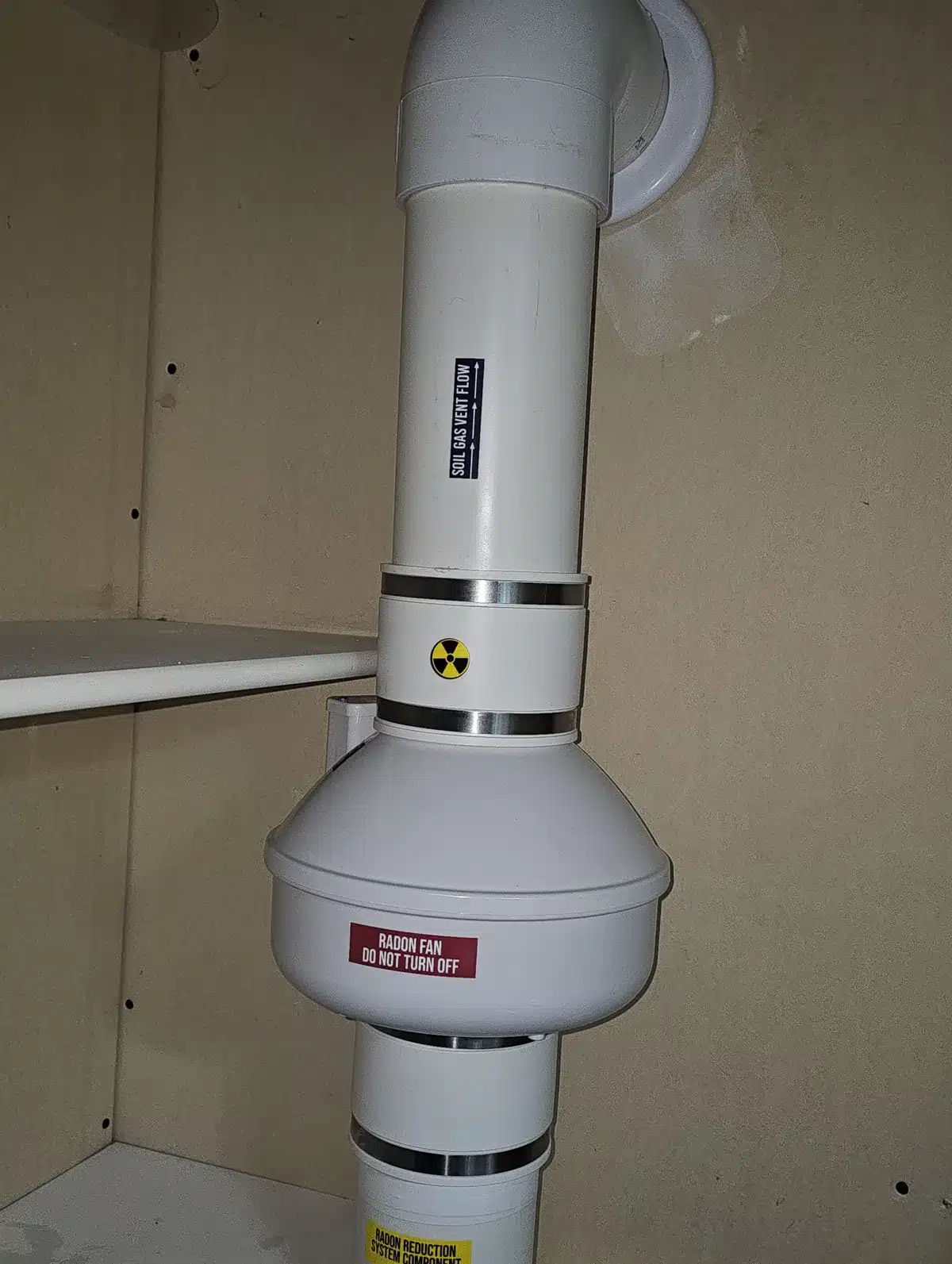
306→<15Bq/m³
Storey-and-a-half, Bonnie Doon area, south-central Edmonton
Late 1940s · basement and crawlspace · no sump pit
The before number is from a detector the owners borrowed from the Edmonton Public Library, about a month in the basement. Then they called us. After the system went in, a four-month lab test through the winter came back under 15.
Readings in Bq/m³ are lab results, except one before reading from a library detector. A “<” is how the lab prints a result below what its detector can measure. Home details are approximate to protect each owner's privacy. Photos are from our installs in Edmonton; two are from similar homes nearby.
Have a result over 200 Bq/m³, or not sure what yours means? Call us and we'll talk it through.
Radon Levels in Edmonton
Are Radon Levels High in Edmonton?
Among the highest of Canada's big cities. In the 2024 Cross-Canada Survey of Radon, about 1 in 6 Edmonton metro-area homes reached Health Canada's radon guideline of 200 Bq/m³ or went past it. Take Action on Radon's winter 2023 study of 163 Edmonton homes found about 1 in 4 over it.
The bigger sample comes first. The 2024 Cross-Canada Survey of Radon, run by the Evict Radon team at the University of Calgary, has more than 2,500 Edmonton metro-area homes in it. Its Edmonton average, 106.4 Bq/m³, edges out Calgary's 102.5, and the survey found these two Prairie cities have the highest averages of Canada's six biggest metro areas.
The winter study was Take Action on Radon's Edmonton project, with every home measured for 91 days. Its own report points out that 163 homes is less than 1% of the city's homes, and that neighbouring houses can test very differently. So a city average can't tell you what's under your own floor. Your own long-term test can. To see where Edmonton sits in the province, see radon by area in Alberta.
Homes at the Guideline or Higher
Edmonton Metro Area, Cross-Canada Survey
16%
Edmonton, Take Action on Radon Study
24%
Highest Edmonton Metro Home, Cross-Canada Survey
1,493Bq/m³
Where the numbers come from. The 2024 Cross-Canada Survey of Radon (p.39 and p.40) tested 2,500+ homes in the Edmonton metro area: 16.2% read 200 Bq/m³ or more, the weighted average was 106.4 Bq/m³ and the top reading 1,493 Bq/m³. Take Action on Radon's Edmonton Community Report (July 2024) tested 163 Edmonton homes for 91 days each in the winter of 2023: 24% read over 200 Bq/m³, 48% read 100 to 200 and 28% under 100. Different homes in different years, so the two sets of numbers don't match.
What Your Radon Level Means
From Fresh Air to Canada's Guideline
Radon is measured in becquerels per cubic metre (Bq/m³). Here is where a long-term result sits next to the levels that matter in Canada, drawn to scale up to 300.
radoncare.ca
5 to 30
85
100
106.4
148 US
200
300
How Homes Here Tested
Share of homes tested in each range of radon levels (Bq/m³)
Edmonton metro area
Under 100
100 to 199
200+
Edmonton, 163 homes
Under 100
100 to 199
200+
About 5 to 30Bq/m³
Fresh outdoor air. Radon from the ground gets diluted in open air, and the level changes from day to day and from region to region.
85Bq/m³
The average Canadian home.
100Bq/m³
The reference level the World Health Organization suggests for countries.
106.4Bq/m³
The average home tested in the Edmonton metro area (2024 survey, weighted).
148Bq/m³
The level where the US Environmental Protection Agency says to fix a home. A US number, shown for reference: Canada uses Health Canada's guideline.
200Bq/m³ (5.4 pCi/L)
Health Canada's guideline. Above it, Health Canada recommends lowering your level within a year, and sooner the higher it is.
300Bq/m³
The upper limit the World Health Organization and European rules set for a country's reference level.
200 is not the goal. Health Canada says no level of radon is risk free, and 200 is not a recommended stopping point if your home can reasonably go lower.
Above 300: How High Radon Can Go
Not drawn to scale
800Bq/m³
Canada's guideline from 1988 to 2007, before it was lowered to 200.
1,493Bq/m³
The highest home tested in the Edmonton metro area in the 2024 survey.
32,321Bq/m³
The highest Canadian home tested in the 2024 survey.
All levels are long-term averages, which is how Health Canada compares a home with its guideline. Sources: Health Canada (200) and its 2012 survey report (800 until 2007), the BC Centre for Disease Control (fresh air, which it puts at about 5 to 15; outdoor levels change from day to day and region to region, so we show a wider band), the World Health Organization and the US EPA (148, for reference), EU Directive 2013/59/Euratom (100 and 300, for reference), and the 2024 Cross-Canada Survey of Radon (85, 106.4, 1,493 and 32,321, and how homes here tested). How homes here tested, also: Take Action on Radon, Edmonton report.
Radon Testing in Edmonton
The Best Way to Test
The test that settles it is a long-term one. Set our long-term test kit out on the lowest floor you spend time on, often a basement family room or bedroom, and leave it three months or more. An Edmonton winter, with the house shut tight, is the right time, and a test this long is what Health Canada recommends. Send it to the lab in the prepaid envelope and you get your home's level back. If it's high, call us and we'll go through what it means for your house.

Long-Term Radon Test Kit
Lab analysis and a prepaid return envelope included. Free shipping in Alberta and BC.
$54.99
Order a Test KitPrefer to watch your levels on a screen? We also sell digital monitors, like the Airthings Corentium Home. It is one of the home radon monitors C-NRPP has tested.

Free Ways to Test in Edmonton
Borrow a detector from the library. Edmonton Public Library lends Airthings radon screening kits from September 1 to April 30, three weeks at a time, with two renewals if no one is waiting. Search “Radon Screening Kit” in the catalogue to place a hold, or ask at your branch. In the fall most kits are out and there's often a waiting list, so check it before you plan around one. A few weeks of screening is a first look, not the answer, so a long-term test should come next. Pick up your hold at any of the 21 branches:
- Abbottsfield - Penny McKee, Calder, Capilano, Castle Downs, Clareview, Heritage Valley, Highlands, Idylwylde (Bonnie Doon), Jasper Place, Lois Hole (Callingwood), Londonderry
- McConachie, Meadows, Mill Woods, Riverbend, Sprucewood, Stanley A. Milner (Downtown), Strathcona, West Henday Promenade (Lewis Estates), Whitemud Crossing, Woodcroft (Westmount)
Know a library or community centre that could use a radon detector? RadonCare may be able to donate one for your community to borrow. Contact us to ask.
When to Test in Edmonton
Start in the fall. The City of Edmonton has declared November Radon Awareness Month, and it's a good month to put a long-term test out: three months through the heating season is the kind of reading Health Canada compares with its guideline (Health Canada).
Test again after a big change. Finishing the basement, adding a suite, new windows, more insulation or a new furnace or HRV can all change your level. The Parkdale home above tested low years ago and high after the owners insulated. More on energy retrofits and radon.
Child care. No Alberta rule says a daycare or day home has to test for radon. A 2017 law would have required it, but it never came into force and was repealed at the end of 2023 (Alberta King's Printer). More on child care and schools.
Are Free Tests Good Enough?
Free detectors from your library are a good first look. Be careful with a free test from a company that also sells radon systems: a test of only a few days, or a detector in the wrong spot, can show a problem a proper test would not. More on what a short test can and cannot tell you.
Why Edmonton Homes Have Radon
Radon is a gas that comes from uranium breaking down in soil and rock, and it is in the ground under every part of Canada. It seeps into a house through the basement floor and foundation, and in a closed-up house it builds up (Health Canada). No public study we know of maps it street by street in Edmonton, and two houses side by side can test very differently.
Newer homes are part of the story. Across Alberta, homes built in recent years have tested higher than older ones: the 2024 survey found new Alberta homes averaging 131.6 Bq/m³, a record high, and the researchers point to many changes in how homes are built and lived in, with no single cause (p.51 and p.52). That matters in a city that has built as fast as Edmonton, where the 2021 census counts about 1 in 5 homes finished in the ten years from 2011 to 2021.
Health Canada says radon is the number one cause of lung cancer in people who don't smoke. Radon has no symptoms, so a test is the only way to know. For questions about radon and your health, talk to your doctor or call Health Link at 811. More on radon and your health.
“The greatest average residential radon levels of the six largest Canadian metropolitan areas are observed in the Prairie cities of Edmonton and Calgary.”
Edmonton Homes and What They Mean for Radon
Older Homes
Roughly 1 in 8 Edmonton homes date from 1960 or earlier, and about 4 in 10 from before 1981 (Statistics Canada, 2021 census). Many have weeping tile but no sump pit: EPCOR says a home built before 1989 likely has weeping tile only. Without a sump, we draw the radon from a suction point through the basement floor, as in the Parkdale home above. Some older Edmonton homes also have furnace ducts running under the basement floor. Ducts like that are uncommon, but if they leak they can carry radon into the air the furnace sends through the house, so we check for them and design the system around them.
Sump Pits
EPCOR says most Edmonton homes built after 1988 have a sump pump working with the weeping tile, and from our job records about 7 in 10 of the Edmonton homes we've fixed had a sump pit. In most of our Edmonton systems, the sealed sump is where the radon is drawn from, alone or with a second point. An open pit is an easy way in for radon, and Alberta's building code requires sump pit covers to be airtight. The lid also has to stay easy to take off, because the pump needs a check every year. Learn more about sealing a sump pit for radon.
Newer Homes
Any Edmonton house whose builder applied after November 1, 2015 should have come with a radon rough-in: a pipe through the basement floor, capped and with no fan (see the building code below). It is a head start, not a system. The Walker-area home above had one and still tested 450 Bq/m³. A newer home still needs a test, and if your builder left a pipe, we test it before using it.
Basement Suites and Renovations
The City of Edmonton warns that "depressurization of the basement can lead to radon exposure" when a basement is developed or a suite is added. If you're finishing a basement or adding a suite, test after the work, not just before. More on energy retrofits and radon.
Townhouses and Condos
Just under half of Edmonton's homes are detached houses. Row houses and semi-detached homes make up about 1 in 6 more, and low-rise apartments nearly 1 in 4 (Statistics Canada, 2021 census). A townhouse with a basement can need a system like any house: the Heritage Valley townhouse above went from 252 to under 26 Bq/m³, drawn from its own sealed sump. More on condos, townhomes and rentals. Radon can be very different from one side of a duplex to the other, so a neighbour's result doesn't tell you yours. Both sides should test.
Renting in Edmonton
In January 2026, Edmonton's public housing provider told the Investigative Journalism Bureau it has no radon testing protocols, and that its future buildings with basements will be designed with radon collection. If you rent, you can test your own home with a long-term kit and share the result with your landlord.
Where the Radon Fan Is Installed
Edmonton's winters add up to about 5,120 heating degree days, far more than the 3,999 that Canada's radon mitigation standard allows for a fan outdoors (National Building Code of Canada 2020, Appendix C; CAN/CGSB-149.12-2024, section 5.8.1.1). In the US, radon fans are often mounted outside, but the standard doesn't allow that anywhere as cold as Edmonton, so here the fan is installed in a heated space, usually the basement or a utility room, sometimes a heated garage. We use fans designed for radon mitigation, so they're sealed properly and won't leak.
What We Find Under Edmonton Floors
Sand is the most common fill under the Edmonton floors we've opened, named on about half of our job reports, then gravel on about 1 in 3. Dirt or clay turns up less often. Which one you'll find depends on when the house was built: in homes from before the radon building code, it's almost always a very fine sand, which air moves through slowly, so suction doesn't reach as far as through gravel. Homes from the 1950s are the exception we see most. Many have pea gravel, likely because the housing standards of the day called for coarse fill under the floor, and it often works as well as gravel under new homes. Most of our Edmonton systems run on a standard-size fan or smaller. We test the pressure under the floor on every house, and where it's dirt or clay, a second suction point goes in when the test shows the house needs one. Why it matters: how a radon system works.
Radon and the Building Code in Edmonton
What New Homes Need, and Since When
The code asks for a radon rough-in in every new Edmonton house the builder applied to build after November 1, 2015. The pipe is capped and nothing pulls on it, so the house still needs a test. Plenty of Edmonton homes are that new: the 2021 census puts roughly 1 in 9 of them in the 2016 to 2021 building years.
Radon Rough-In Required
New Homes in Alberta, Since
2015
Fan Required by Code
No
Code Dates for Edmonton
- November 1, 2015: Every new home the builder applied to build after this date has Alberta's radon rough-in, a capped pipe through the basement floor. The code that brought it in, the Alberta Building Code 2014, took effect May 1, 2015, with a six-month window when builders could still choose the old code (Government of Alberta).
- December 1, 2019: Under the National Building Code (Alberta Edition) 2019, the rough-in pipe must also carry a label (Government of Alberta).
- May 1, 2024: The National Building Code (Alberta Edition) 2023 takes effect and is today's code. The rough-in stays, and a fan is still not required (Government of Alberta).
What It Means for Your Home
With nothing running through it, the rough-in only pays off once a system is built on it. Test first. If the number comes back high, we look over the builder's pipe before using it, and if it's in a bad spot we put our suction point where it works best. The whole Alberta history: radon in the Alberta Building Code.
What the City of Edmonton Asks For
The City asks builders to show the radon rough-in on a new house's foundation plan, with its end clearly labelled and placed so a pipe can later be run outside, not under the stairs or too close to an appliance. The same list asks for the sump pit with an airtight lid. The City's radon rough-in sheet quotes the code's own note that a full system "may be necessary to reduce the radon concentration to a level below the guideline".
The City's published inspection checklist for houses lists four inspections, from the footings to the final, and none of them names radon or soil gas. So a builder's pipe is worth testing before anyone relies on it: we check it has suction under the floor before we put a fan on it.
Radon in Alberta: The Bigger Picture
What your number means, how a system works, the price, grants and the rules for buying or selling a home are the same across Alberta, so they're on one page: What your level means · Radon and your health · How mitigation works · What changes the price · Grants and help paying · Alberta code history · Buying or selling · More radon questions
Edmonton Radon Questions
Is Radon a Problem in Edmonton?
Yes. In the 2024 Cross-Canada Survey of Radon, Edmonton and Calgary had the highest averages of Canada's six biggest metro areas, and about 1 in 6 Edmonton metro-area homes reached the 200 Bq/m³ guideline or went over it. Take Action on Radon's winter tests found 24% of 163 Edmonton homes over it.
Which Edmonton Neighbourhoods Have the Most Radon?
The public studies we rely on, the 2024 survey and Take Action on Radon's Edmonton report, give results for the city as a whole, not by neighbourhood. Next-door houses can test far apart, so the house down the street tells you nothing certain about yours. Our five homes above are spread across the city, from Parkdale to Heritage Valley: high radon turns up in every part of Edmonton, old homes and new. Test your own home.
My Newer Edmonton Home Has a Radon Pipe. Do I Still Need to Test?
Yes. The pipe the code asks for is capped, with no fan on it, so it lowers nothing until a system is built on it. The Walker-area home above had one and still tested 450 Bq/m³. Test first, and if the result is high, we'll check the pipe has suction under the floor before we use it.
How Does the City of Edmonton Handle the Radon Rough-In?
The City asks for the rough-in on a new house's foundation plan, labelled and placed so it can later be run outside. Its published inspection checklist for houses doesn't list a radon item, though, so nobody should assume the pipe has been checked. See Radon and the Building Code in Edmonton.
When Is the Best Time to Test for Radon in Edmonton?
Fall and winter. November is Radon Awareness Month for the City of Edmonton, and a long-term test started then runs through the heating season, with the windows shut for the cold, the time Health Canada prefers (Health Canada). The library lends its screening kits from September to April.
Where Can I Get a Radon Test Kit in Edmonton?
Our long-term test kit can be ordered online, with the lab analysis included and free shipping anywhere in Alberta. For a free first look, Edmonton Public Library lends screening kits from September to April. See Radon Testing in Edmonton.
Do You Work Around Edmonton?
Yes. St. Albert, Sherwood Park, Spruce Grove and Leduc each have their own page. We also work in Beaumont, Stony Plain, Fort Saskatchewan and on acreages around the city. Not sure about your area? Give us a call.
How Much Does Radon Mitigation Cost in Edmonton?
A radon system costs a fraction of the price of air conditioning. What yours costs comes down to the house. Many Edmonton homes have a sump pit, which we seal airtight and often draw from, and older homes without one get a suction point through the basement floor. Tell us a little about your basement and we can usually give you a price on that same call. See what changes the price.
Why Doesn't RadonCare Offer Free Radon Tests?
A radon test is only worth acting on if it's done properly: three months or more, in the lowest level of the house you actually use. We only recommend a system when a test like that shows your home needs one. If you'd like a free first look, borrow a screening kit from Edmonton Public Library, then follow it with a long-term test.
Is There a Grant for Radon Mitigation in Edmonton?
At the time of writing (October 2026), there is no Alberta, regional or city grant for radon mitigation. Anything we missed? Let us know. Two charities can help: the Canadian Lung Association's Lungs Matter program, if you have been diagnosed with lung cancer, or your household has a low to moderate income, and Alberta Lung, in radon season, if you have been affected by lung cancer. See grants and help paying.
Areas We Serve Around Edmonton
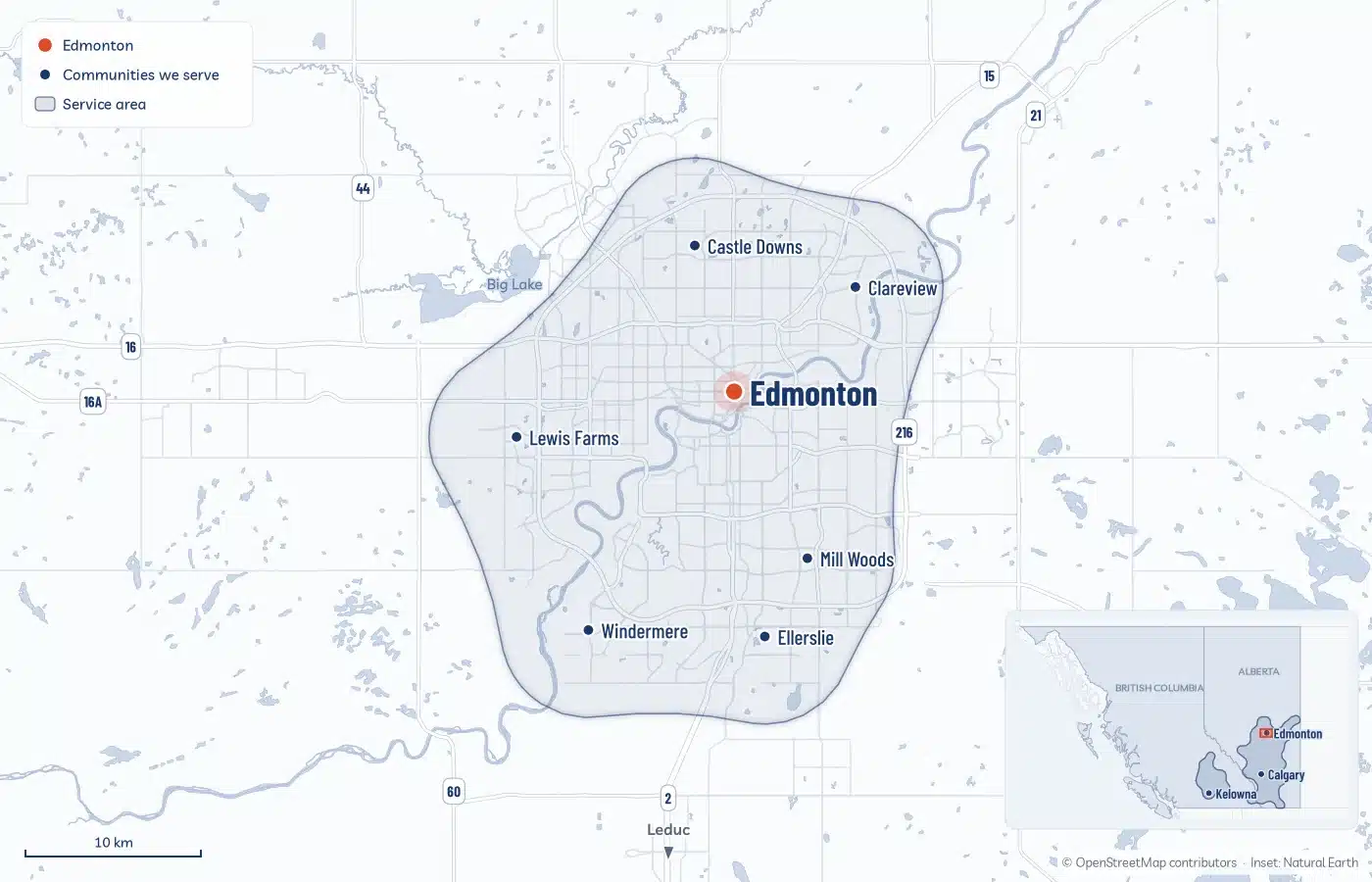
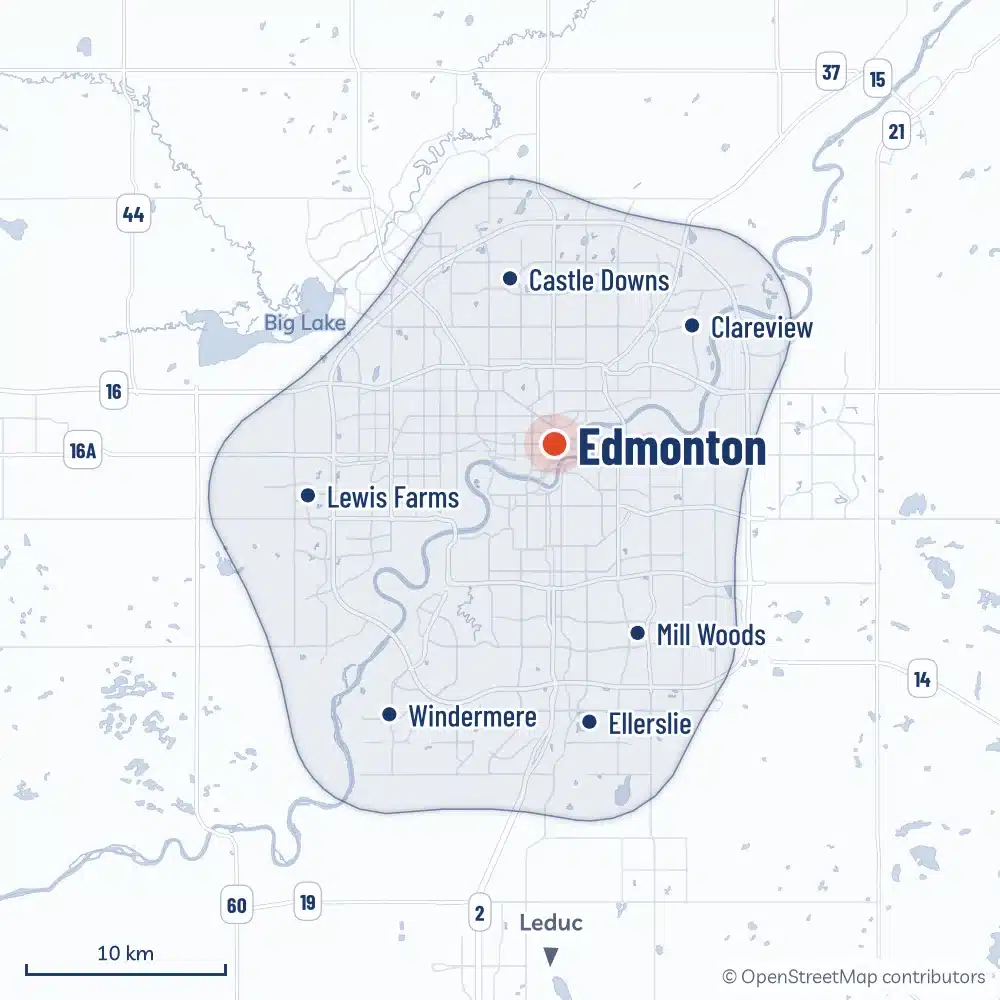
We work across the City of Edmonton, from Castle Downs and Clareview in the north to Windermere, Heritage Valley and Ellerslie in the south, and from Lewis Farms in the west to Mill Woods in the southeast, older neighbourhoods like Parkdale, Highlands and Bonnie Doon included. Beaumont, Stony Plain and Fort Saskatchewan too: call us.
Nearby Areas We Serve
Outside This Map? We Work Across Alberta and the BC Interior.
Our crews also work in Red Deer and Calgary, and across the BC Interior. Not sure about your town? Call 1‑844‑723‑6622.
Radon in the Local News
Investigative Journalism Bureau, January 27, 2026High levels of deadly radon gas found in 21% of social housing unitsA national look at radon in social housing. Edmonton's public housing provider is quoted.
CTV News Edmonton, December 21, 2024‘Radon exists everywhere’: How to detect and keep the harmful gas out of your home
Global News, October 23, 2024New study shows dangerous levels of radon gas in millions of Canadian homesOn the 2024 survey: about 1 in 6 homes in Calgary and Edmonton at or above the guideline.
Edmonton Public Library, November 4, 2019Radon Screening Kits Available at EPLHow the library's kits started, with the Alberta Lung Association, Health Canada and the City.
Get a Free Quote or Ask a Question
Fill out the form and a radon expert will get in touch to answer your questions. Prefer to talk? Call 1‑844‑723‑6622.
About RadonCare
We've lowered the radon in every building we've ever worked on: more than 3,000 homes across Alberta and British Columbia, plus schools, apartment buildings and government buildings. We started out in heating and ventilation, so our team of C-NRPP certified professionals designs every system from how air actually moves through your house, and we aim for the lowest level your home can reasonably reach, not just under the guideline. From your first test to a system built for your home, the results are guaranteed. RadonCare is a five-time Consumer Choice Award winner, and we're involved in Canada's radon industry, with seats on the CARST board of directors and the C-NRPP advisory board.
Updated October 2026