
3,000+ Homes Mitigated Across Alberta and British Columbia · Guaranteed Results
Radon Mitigation and Testing in Calgary
Of Canada's six largest metropolitan areas, Calgary and Edmonton have the most radon in their homes on average, and one home in six across the Calgary metro area tested at 200 Bq/m³ or more, Health Canada's guideline (2024 Cross-Canada Survey of Radon). RadonCare tests for radon gas and fixes it in homes across Calgary, Chestermere, Langdon and Strathmore. Questions about a test or a result? Call us.
Not tested yet? Start with a test kit →
Got a reading from a library detector or a free kit? Call and talk to a radon expert about what it means for your home.
On this page: Our Results · Radon Levels · Radon by Area · Testing · Building Code · FAQ · Free Quote

★★★★★ 4.9
280+ Google reviews

★★★★★ 4.9
on HomeStars


C-NRPP Certified

Consumer Choice Award winner, 2022 to 2026

Partner in radon research led by the University of Calgary

Radon partner in Alberta
Our Radon Mitigation Work in Calgary
Just a Few of Our Results From the Area
Calgary keeps our crews busy all year, in inner-city infills and duplexes as much as in new homes at the city's edges. When a Calgary-area owner mails a lab test back after the install, the result is usually very low: in our job records, checked against each lab report, about 3 in 4 read under 30 Bq/m³ and about 9 in 10 under 50.
An infill with heat in the slab and a duplex with a finished basement don't get the same system: each one is designed for the house it goes in. Canada's national standard for radon mitigation (CAN/CGSB-149.12-2024, section 1) says a system that is properly designed and installed by certified professionals can lower radon by about 90% or more. How well a system works comes down to who designs and installs it. We've lowered the radon in every home and commercial building we've ever worked on. Every system we install comes with guaranteed results.
Tricky homes are the ones our technicians enjoy most. Even after more than 3,000 homes, we still run into something new now and then, and when we do, the whole team works on it together, so every job has the experience of all our crews across Alberta and BC behind it.
The Five Homes Below
Before Mitigation
223 to 530Bq/m³
After
15 to 31Bq/m³
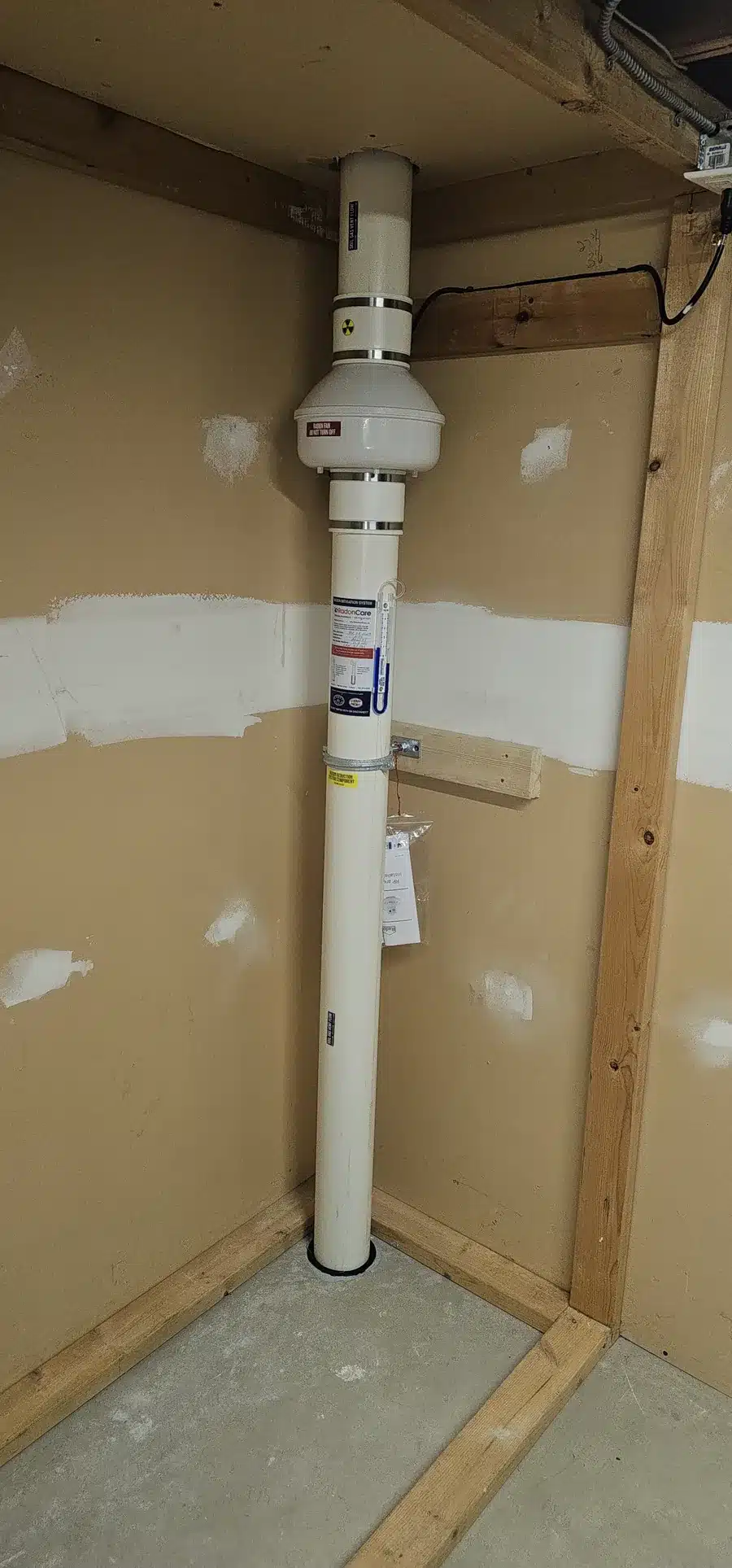
223→15Bq/m³
Inner-city duplex, southwest Calgary
2000s duplex · finished basement · sealed sump
Lab tests before and after, each about three months. We sealed the sump, drew the radon from under the slab and kept the fan in a storage room, so the finished rooms were left alone.
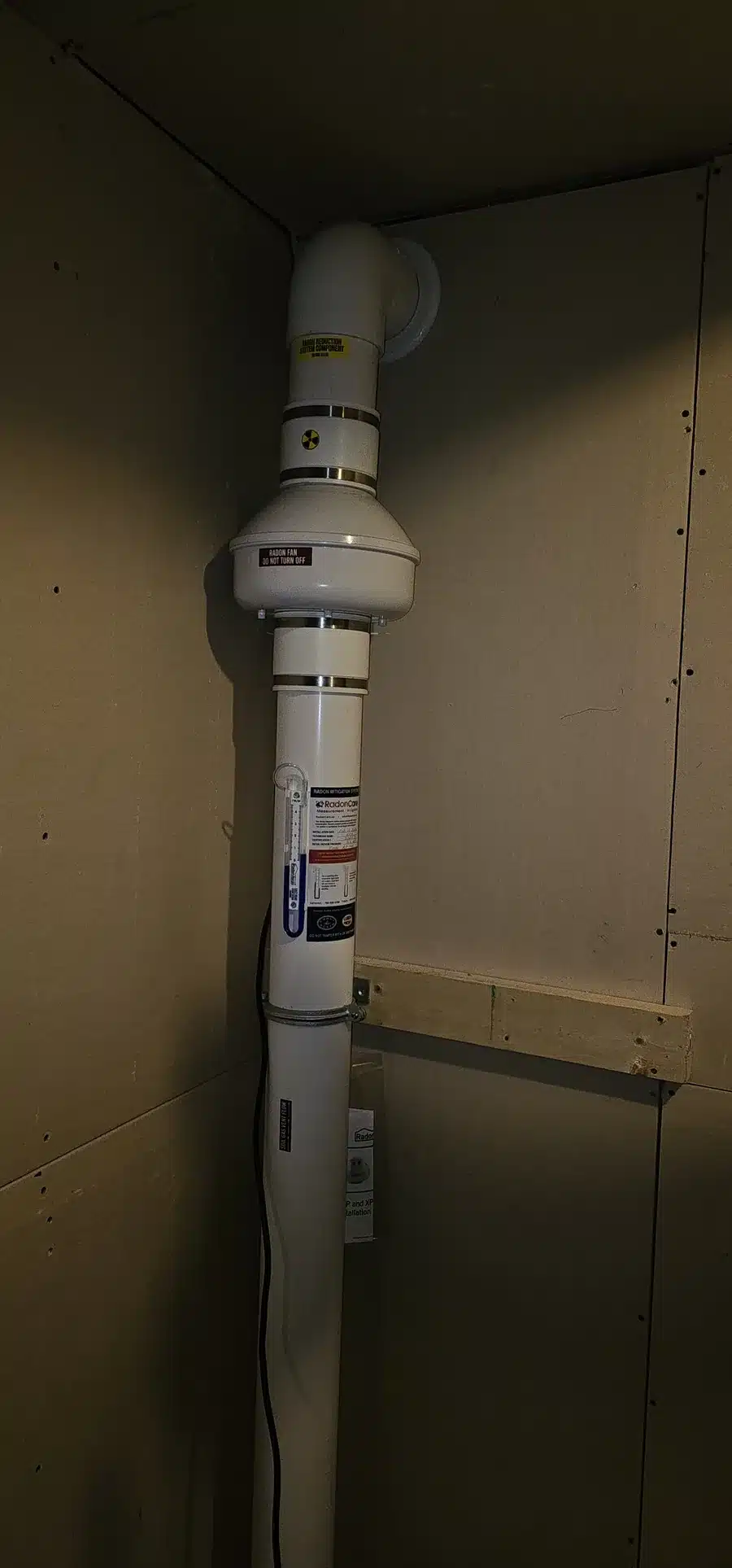
400 to 500→15Bq/m³
Two-storey, Somerset, southwest Calgary
Late 1990s · finished basement · forced air with A/C
The owner's monitor read 400 to 500 Bq/m³. The fan went on a framed wall in the one unfinished corner.
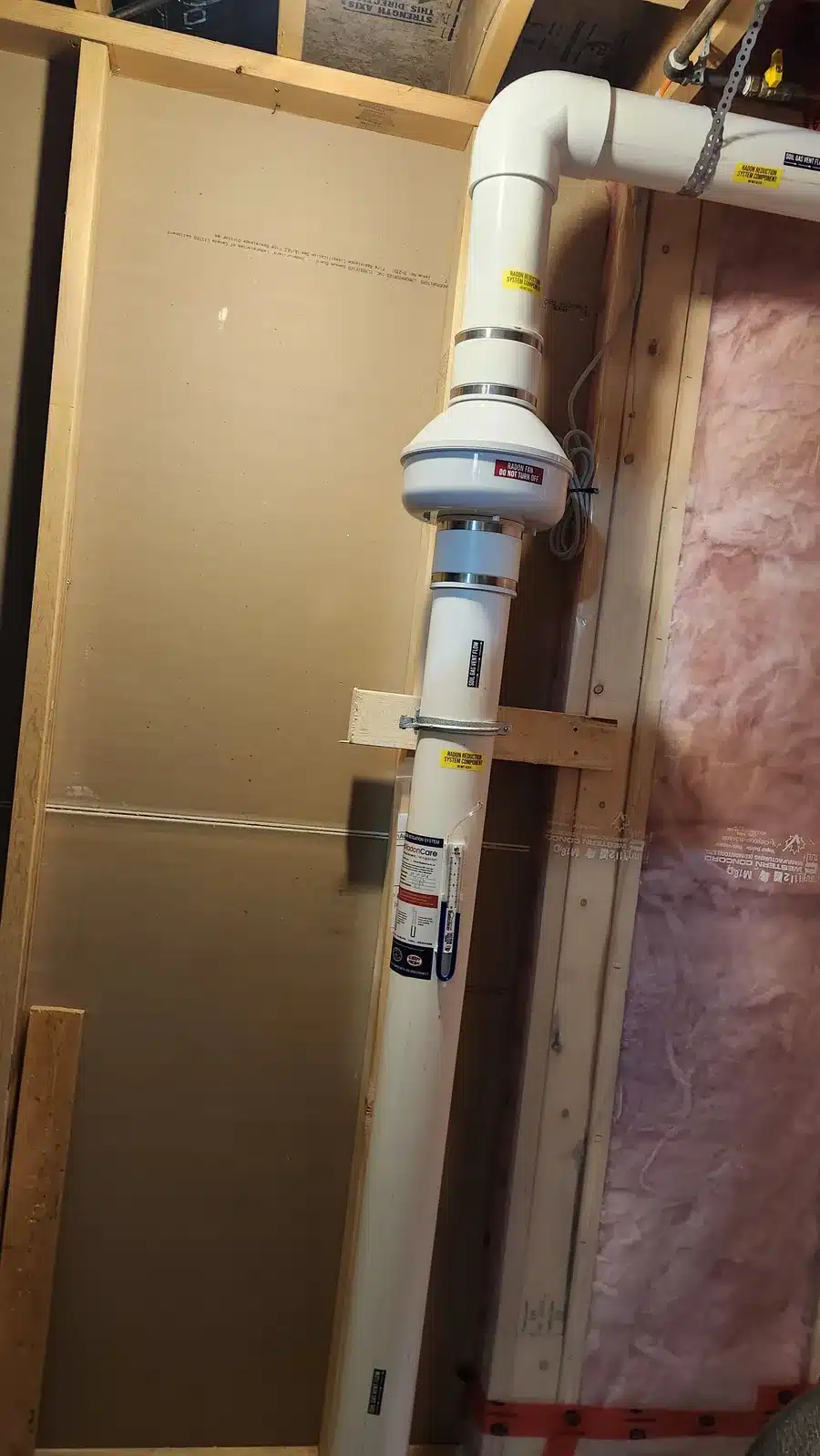
302→15Bq/m³
Newer two-storey, Auburn Bay, southeast Calgary
2010s · developed basement · HRV
A newer home, and still well over the guideline on a three-month test.
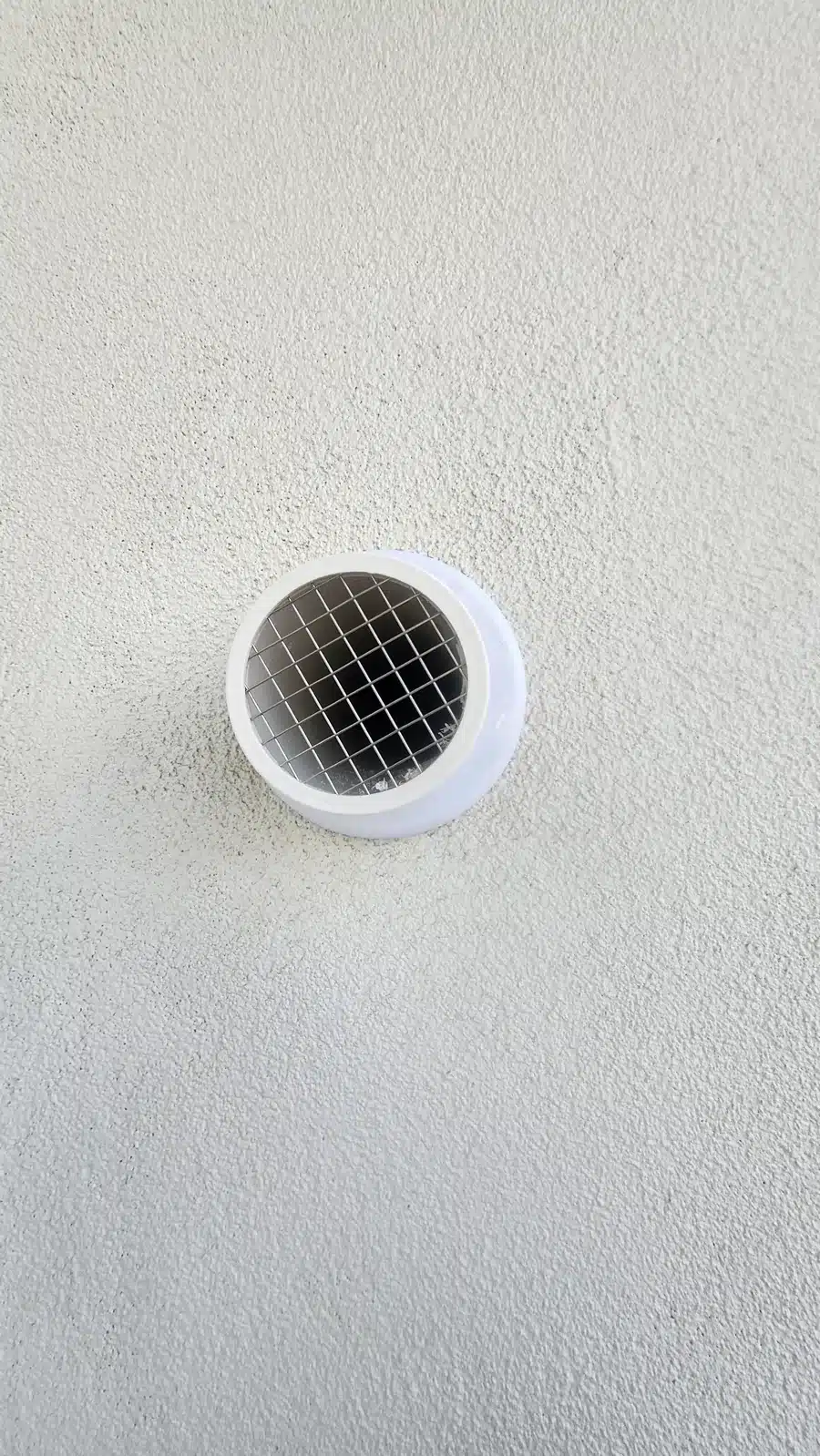
530→31Bq/m³
Infill, northwest Calgary
2010s infill · in-floor heat · sealed sump · HRV
Two lab detectors read 458 and 530 Bq/m³ before. The pipe runs through the garage ceiling and out a stucco wall, so nothing shows inside.
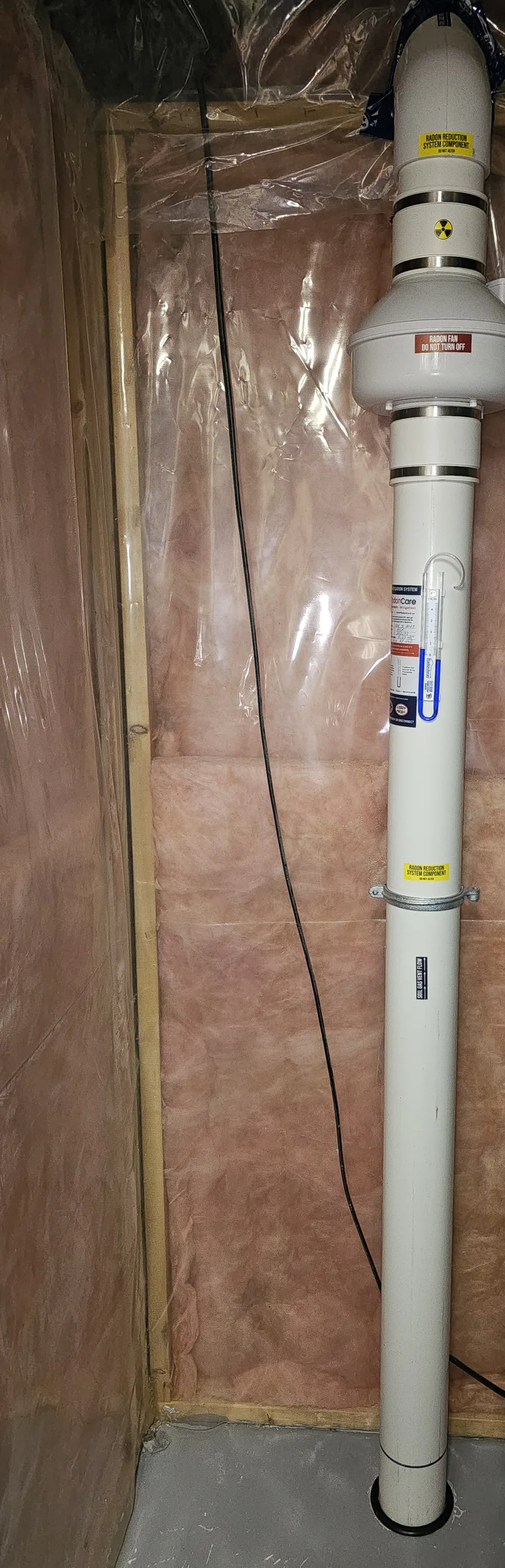
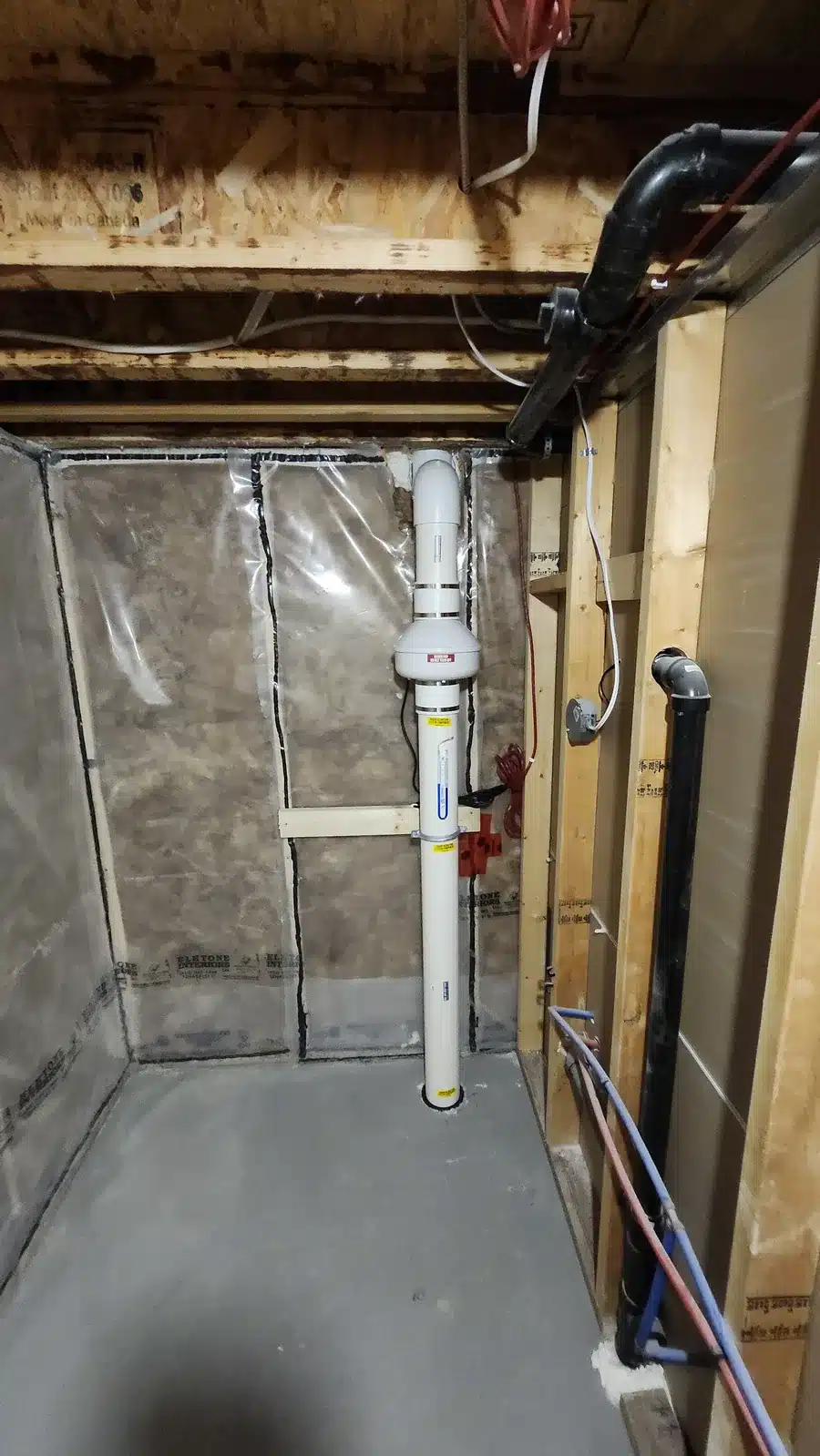
331→22Bq/m³
Strathmore
2010s home · hanging furnace · sealed sump
The open ground under the furnace and the sump were sealed first. Photo from one of our Calgary-area installs.
Readings in Bq/m³. Every after result here is a lab test of about three months or more; befores are long-term tests, lab tests or the owner's monitor, and a monitor's range stays a range. Where two lab detectors were used, the higher one is shown. Home details are approximate to protect each owner's privacy. Photos are from our installs in the Calgary area.
Have a result over 200 Bq/m³, or not sure what yours means? Call us and we'll talk it through.
Radon Levels in Calgary
What Local Tests Have Found
One home in six tested across the Calgary metro area came in at 200 Bq/m³ or higher, Health Canada's radon guideline, and more than 1 in 3 landed between 100 and 199 Bq/m³.
Those figures come from the 2024 Cross-Canada Survey of Radon, which Evict Radon runs out of the University of Calgary. Of the country's six largest metropolitan areas, homes in Calgary and Edmonton averaged the highest. The Calgary metro area's average, 102.5 Bq/m³, is more than twice Toronto's and about six times Vancouver's.
The survey also splits the Calgary metro area by type of house. Semi-detached houses tested about the same as detached ones, at about 1 in 6 over the guideline. Row houses came out lower, near 1 in 10, but not free of it. East of the city, Strathmore tested higher still, and the survey lists it with High River and Okotoks among the Canadian towns where between a quarter and a half of homes reach 200 Bq/m³ or more.
Still, an area figure says nothing certain about one house: only a long-term test of your own home does. See how other parts of Alberta compare.
Homes Over the Guideline
Calgary Metro Area, Cross-Canada Survey
1 in 6
Row Houses, Calgary Metro Area, Cross-Canada Survey
1 in 10
Strathmore, Cross-Canada Survey
More than 1 in 4
Calgary metro area: weighted average 102.5 Bq/m³, 15.5% at or above 200 and 36.9% from 100 to 199, highest home 3,872 Bq/m³, from 2,500 or more homes (p.39-40). By type of house: single-detached 16.4%, semi-detached 16.0% and row houses 9.8% at or above 200 (p.51). Toronto 43.0 and Vancouver 17.1 (p.40). Strathmore: 28.3% at or above 200, highest 1,175 Bq/m³, from 50 to 99 homes, a small sample (p.44), and the towns named on p.10. All from the 2024 Cross-Canada Survey of Radon.
What Your Radon Level Means
From Fresh Air to Canada's Guideline
Radon is measured in becquerels per cubic metre (Bq/m³). Here is where a long-term result sits next to the levels that matter in Canada, drawn to scale up to 300.
radoncare.ca
5 to 30
85
100
102.5
148 US
200
300
How Homes Here Tested
Calgary metro area, all homes and by type of house: share tested in each range of radon levels (Bq/m³)
Calgary metro area, all homes
Under 100
100 to 199
200+
Single-detached houses
Under 100
100 to 199
200+
Semi-detached houses
Under 100
100 to 199
200+
Row houses
Under 100
100 to 199
200+
About 5 to 30Bq/m³
Fresh outdoor air. Radon from the ground gets diluted in open air, and the level changes from day to day and from region to region.
85Bq/m³
The average Canadian home.
100Bq/m³
The reference level the World Health Organization suggests for countries.
102.5Bq/m³
The average home tested in the Calgary metro area (2024 survey, weighted).
148Bq/m³
The level where the US Environmental Protection Agency says to fix a home. A US number, shown for reference: Canada uses Health Canada's guideline.
200Bq/m³ (5.4 pCi/L)
Health Canada's guideline. Above it, Health Canada recommends lowering your level within a year, and sooner the higher it is.
300Bq/m³
The upper limit the World Health Organization and European rules set for a country's reference level.
200 is not the goal. Health Canada says no level of radon is risk free, and 200 is not a recommended stopping point if your home can reasonably go lower.
Above 300: How High Radon Can Go
Not drawn to scale
800Bq/m³
Canada's guideline from 1988 to 2007, before it was lowered to 200.
3,872Bq/m³
The highest home tested in the Calgary metro area in the 2024 survey.
32,321Bq/m³
The highest Canadian home tested in the 2024 survey.
All levels are long-term averages, which is how Health Canada compares a home with its guideline. Sources: Health Canada (200) and its 2012 survey report (800 until 2007), the BC Centre for Disease Control (fresh air, which it puts at about 5 to 15; outdoor levels change from day to day and region to region, so we show a wider band), the World Health Organization and the US EPA (148, for reference), EU Directive 2013/59/Euratom (100 and 300, for reference), and the 2024 Cross-Canada Survey of Radon (85, 102.5, 3,872 and 32,321, and how homes here tested).
Radon by Area Around Calgary
Every Quadrant Has Homes Over the Guideline
Radon in Calgary doesn't follow the quadrants. In the University of Calgary's tests from 2013 to 2016, a different set of homes from the 2024 survey, about 1 in 8 or 9 homes in every part of the city were at or above 200 Bq/m³.
The University of Calgary study (CMAJ Open, 2017) covered 2,382 homes in Calgary and southern Alberta, each tested for three months or more. The authors found "no areas with uniformly low household radon levels", and the highest home in the four quadrants was in the northwest.
Strathmore, east of the city, has its own figure in the newer 2024 survey, and it ran higher. Levels vary from house to house, even on the same street, so test your own home.
- Northwest Calgary: 11% at or above 200 Bq/m³
- Northeast Calgary: 13%
- Southwest Calgary: 12%
- Southeast Calgary: 11%
- Strathmore (2024 survey): 28%
Quadrants: Stanley et al., CMAJ Open 2017, Figure 2, tests of 90 days or more, 2013 to 2016. Strathmore: 2024 Cross-Canada Survey of Radon, p.44. Two studies, different years: compare within each, not across.
Radon Testing in Calgary
The Best Way to Test
A Calgary winter, with the house shut tight and the furnace running, is when a test tells you the most. Our long-term test kit sits in the lowest lived-in level of your home for three months or more, the kind of test Health Canada recommends, and then you mail it to the lab in the prepaid envelope. The City of Calgary gives the same advice if you hire someone: a certified professional and a test of at least three months (City of Calgary). If your result is high, call us and we will talk it through.

Long-Term Radon Test Kit
Lab analysis and a prepaid return envelope included. Free shipping in Alberta and BC.
$54.99
Order a Test KitPrefer to watch your levels on a screen? We also sell digital monitors, like the Airthings Corentium Home. It passed C-NRPP's testing of home radon monitors.

Free Ways to Test in and Around Calgary
Free kits in southwest Calgary. In fall 2026, the SCA Community Association, for Strathcona, Christie and Aspen, took part in Take Action on Radon's 100 Radon Test Kit Challenge, with 100 free kits for local residents. The program is over, and we don't know whether there will be another one. If you missed it, you can still run a long-term test in your home.
Borrow a detector in Chestermere, Langdon or Strathmore. The Marigold Library System, with Alberta Lung, lends 18 radon screening kits from October to April, three weeks at a time. Place a hold in TRACpac by searching "Marigold Radon Detector". With 18 kits for the whole system, check one is free before you count on it. Marigold says the kits are a first screening and a three-month test gives the real average. Marigold libraries near Calgary:
- Chestermere Public Library
- Langdon Community Library
- Strathmore Municipal Library
Know a library or community centre that could use a radon detector? RadonCare may be able to donate one for your community to borrow. Contact us to ask.
Schools and Child Care in Calgary
Schools. The Calgary Board of Education tested 10 of its 225 schools in 2014 and 2015, and all 10 were under 200 Bq/m³ (CBC News). It tested 27 more over the 2019-20 school year (Calgary Board of Education, 2020). The Calgary Catholic School District said in 2019 it would test all 115 of its schools, and after testing 40% of them had found three locations to fix (CBC News). If you're not sure about your child's school, ask the school.
University of Calgary. The university began testing its student residences, student family housing and child care centres in the fall of 2018 (UCalgary News).
Child care. A Calgary daycare or day home doesn't have to test for radon. Alberta passed a law in 2017 that would have required it, but it never came into force and was repealed at the end of 2023 (Alberta King's Printer). Ask your centre if it has tested. More on child care and schools.
Are Free Tests Good Enough?
A free test from a public program is a good first look. Be careful with a free test from a company that also sells radon systems: a test of only a few days, or a detector in the wrong spot, can show a problem a proper test would not. More on what a short test can and cannot tell you.
Why Radon Runs High in Calgary
Radon forms naturally as uranium breaks down in soil and rock (Health Canada), and it is common across the Prairies (University of Calgary study, CMAJ Open, 2017). As a house is heated in winter, it draws soil gas up through the basement floor and walls, which is why a test through the cold months tells you the most.
How Calgary builds plays a part too. Across Alberta, the 2024 survey found radon climbing with the year a home was built, by about 39 Bq/m³ on average from 1971 to 2024, with the newest homes averaging 131.6 Bq/m³. Its authors give bigger floor plans as one possible reason: a bigger slab shrinks more as it cures and leaves wider gaps around the edge of the floor. The University of Calgary study saw the same pattern here: homes from 1992 on averaged about a third more radon than older ones.
Health Canada says radon is the number one cause of lung cancer in people who don't smoke. Radon has no symptoms, so a test is the only way to know. For questions about radon and your health, talk to your doctor or call Health Link at 811. More on radon and your health.
“Albertan residential properties are currently being constructed with record-high radon levels.”
Calgary Homes and What They Mean for Radon
Sump Pits
About 1 in 5 of the Calgary-area homes we work on has a sump (from our job records). An open pit is an easy way in for radon, and Alberta's building code requires sump pit covers to be airtight. The lid also has to stay easy to take off, because the pump needs a check every year. Learn more about sealing a sump pit for radon.
Hanging Furnaces
About 2 in 5 of the Calgary-area homes we work on have a hanging furnace (from our job records). In many Calgary-area homes built before about 2020, the furnace was hung from the floor joists before the basement concrete went in, and the concrete didn't always fill in underneath. That leaves a gap to the soil below the furnace, where the furnace's blower motor can mine radon into the home and push it through the ducts, sometimes making the main floor read higher than the basement. We check under the furnace on every install, and if there's a gap, we fill it with poured concrete.
Houses, Duplexes and Row Homes
Just over half of Calgary's homes are single-detached houses (Statistics Canada, 2021 census). In the survey's Calgary figures, a semi-detached house is about as likely as a detached one to be over the guideline, and a row house less likely. Inner-city infills and duplexes are a big part of our work here, often with a sealed sump or heat in the slab, and we plan the pipe around them. Radon can be very different from one side of a duplex to the other, so a neighbour's result doesn't tell you yours. Both sides should test.
Newer Homes
Calgary keeps growing: roughly one home in eleven went up between 2016 and 2021, and nearly 4 in 10 since 2001 (Statistics Canada, 2021 census). Half of the Calgary homes we've fixed went up in 2001 or later, newer than the city as a whole (from our job records). A home the builder applied to build after November 1, 2015 has a radon rough-in, but no fan, so it still needs a test.
Acreages and Wells
Homes in Calgary, Chestermere and Strathmore are on the City of Calgary's treated water. Out on the acreages of Rocky View County and around Langdon, some homes rely on private wells. A 2024 national study led by the University of Calgary found that rural homes had up to about 30% more radon on average than city homes, and linked most of that gap to living near a drilled water well, not to using its water. If you live outside the city, test your home.
Where the Radon Fan Is Installed
A Calgary winter runs to about 5,000 heating degree days, a measure of how cold a place is over a year (National Building Code of Canada 2020, Appendix C). Canada's radon mitigation standard lets a radon fan go outdoors only where that figure is 3,999 or lower (CAN/CGSB-149.12-2024, clause 5.8.1.1). In the US, radon fans are often mounted outside. Canada's radon standard doesn't allow that anywhere as cold as Calgary, so here the fan is installed in a heated space, usually a basement, a utility room or a heated garage. We use fans designed for radon mitigation, so they're sealed properly and won't leak.
What We Find Under Calgary Floors
About 6 in 7 Calgary-area homes we work on have gravel or crushed rock under the basement slab, and most of the rest have gravel mixed with dirt, sand or clay (from our job records). Gravel lets one suction point reach a long way, so most homes here need only a standard radon fan; only a few need a high-suction one. Why it matters: how a radon system works.
Radon and the Building Code in Calgary
What New Homes Need, and Since When
If the builder of your Calgary home applied to build after November 1, 2015, the house went up under the Alberta Building Code 2014 or a newer edition and has a radon rough-in: a capped pipe through the basement floor. That pipe is not a radon system. Nothing pulls air through it, so the home still needs a test.
Radon Rough-In Required
New Homes in Alberta, Since
2015
Fan Required
Never
Code Dates for Calgary
- May 1, 2015: The Alberta Building Code 2014 brings in the first radon rough-in, required for homes the builder applied to build after November 1, 2015 (either code was allowed until then) (Government of Alberta).
- Homes the builder applied to build from December 1, 2019: The pipe has to be labelled (Government of Alberta).
- Homes the builder applied to build from May 1, 2024: The current code, still no fan required (Government of Alberta).
- Calgary today: An addition that adds to a home's footprint needs its own rough-in (City of Calgary).
What It Means for Your Home
If you want a system later, we test the pipe before using it. More on radon in the Alberta Building Code.
In Calgary: Additions and Older Homes
An existing home doesn't need a rough-in: in the City's words, it "is not a building code requirement for existing homes". A house the builder applied to build before November 2015 likely has none, so after you add a family room or a sunroom on a slab, only the new part has one. A test after the work tells you where the whole house stands. The City's own radon page has more on testing and renovating.
Radon in Alberta: The Bigger Picture
What your number means, how a system works, the price, grants and the rules for buying or selling a home are the same across Alberta, so they're on one page: What your level means · Radon and your health · How mitigation works · What changes the price · Grants and help paying · Alberta code history · Buying or selling · More radon questions
Calgary Radon Questions
Is Radon a Problem in Calgary?
Yes. Calgary and Edmonton have the most radon on average of Canada's six largest metro areas, and one home in six across the Calgary metro area tested at 200 Bq/m³ or more (2024 Cross-Canada Survey of Radon). A University of Calgary study found homes over the guideline in all four quadrants. Only a long-term test tells you about your own home.
Which Areas of Calgary Have the Most Radon?
No quadrant stands out. In the University of Calgary study, 11% to 13% of homes in each quadrant reached 200 Bq/m³ or more, and the highest home was in the northwest. East of the city, Strathmore tested higher in the 2024 survey. See Radon by Area Around Calgary. Your street can't tell you your level; a test can.
Does It Matter If I Live in a Duplex or Townhouse?
Less than you might think. In the 2024 survey's Calgary figures, semi-detached houses tested about the same as detached ones, with about 1 in 6 reaching 200 Bq/m³ or more. Row houses were lower, about 1 in 10, but not radon free. Any home with a floor or wall against the ground can have it, so test the lowest level you live in. Radon can be very different from one side of a duplex to the other, so a neighbour's result doesn't tell you yours. Both sides should test.
My Newer Calgary Home Has a Radon Pipe. Do I Still Need to Test?
Yes. The code has called for that pipe in new Calgary homes since late 2015, but no Alberta code has ever asked for a fan, so the pipe just sits capped in the basement. Test first, and if your result is high, we check the pipe before we use it.
Do You Work in Chestermere, Langdon or Strathmore?
Yes. We work in every part of Calgary and east to Chestermere, Langdon and Strathmore. North, west and south of the city, see our Airdrie, Cochrane and Okotoks pages. If your area is not on the map below, give us a call.
How Much Does Radon Mitigation Cost in Calgary?
A radon system costs a fraction of the price of air conditioning. What you pay depends on your house. In many Calgary homes, sealing a hanging furnace or a sump is part of the job, and the gravel under most slabs here keeps the rest of the work simple. Tell us a little about your basement when you call, and most of the time we can give you a price before we hang up. See what changes the price.
Can You Repair or Replace a Radon Fan?
Yes. If it's one of our systems, call us and we'll sort it out. If another company installed it, call us first for advice: we'll walk you through what to check, and if the system needs more than a fan, we'll quote a system of our own design.
Why Doesn't RadonCare Offer Free Radon Tests?
Because we want the test done right. A proper test runs for at least three months in the lowest lived-in level of your home, and we only recommend a system when a test shows your home needs one. For a free first look, try a Marigold library kit in Chestermere, Langdon or Strathmore, then follow up with a long-term test.
Is There a Grant for Radon Mitigation in Calgary?
At the time of writing (October 2026), we have found no radon mitigation grant from the City of Calgary, Chestermere, Strathmore, Rocky View County or the Government of Alberta. If you know of one, let us know. Two charities can help: the Canadian Lung Association's Lungs Matter program, if you have been diagnosed with lung cancer, or your household has a low to moderate income, and Alberta Lung, in radon season, if you have been affected by lung cancer. See grants and help paying.
Areas We Serve Around Calgary
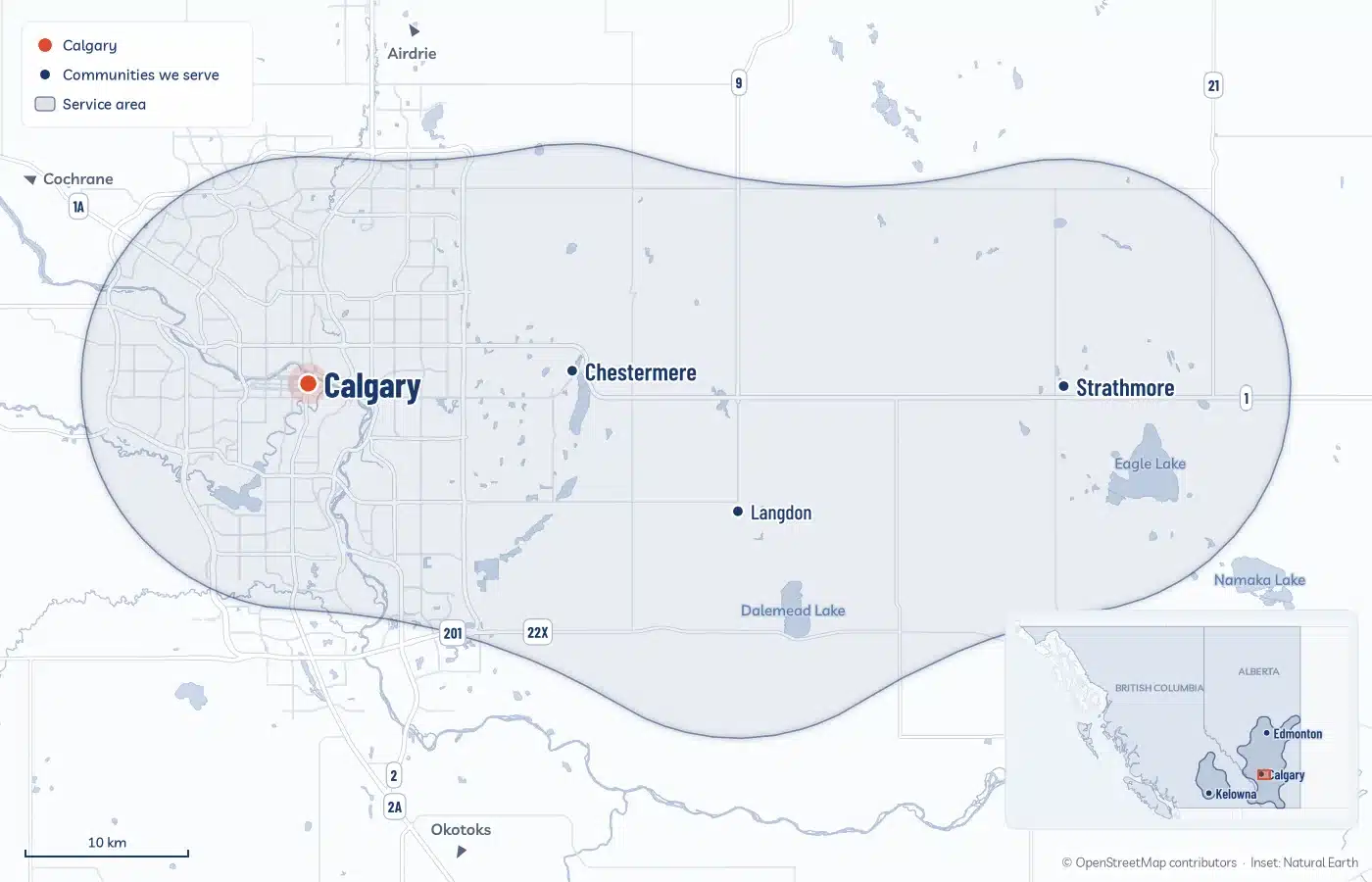
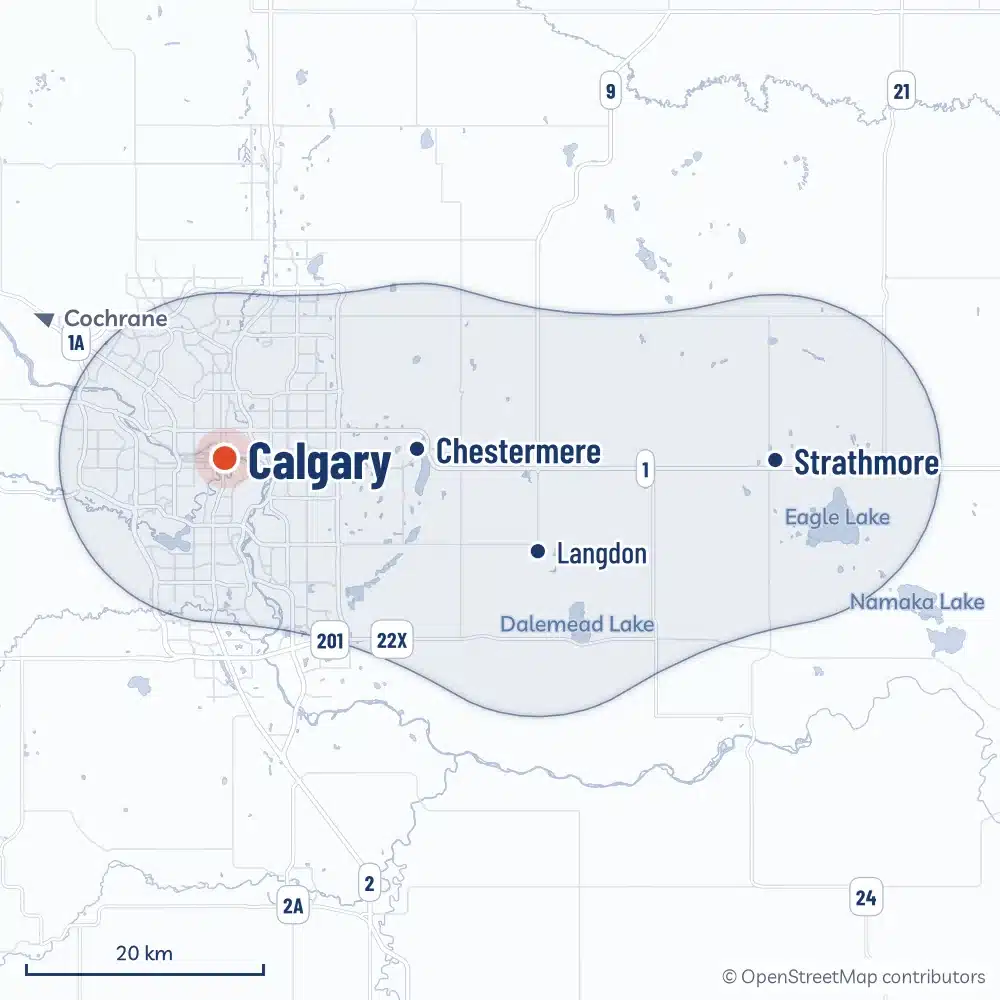
We work in all of Calgary's 200-plus communities, from the inner city to the newest neighbourhoods at the city's edges, and east to Chestermere, Langdon and Strathmore.
Nearby Areas We Serve
Outside This Map? We Work Across Alberta and the BC Interior.
Our crews also work in Red Deer, Edmonton, St. Albert and Sherwood Park, and across the BC Interior. Not sure about your town? Call 1‑844‑723‑6622.
Radon in the Local News
Calgary Herald, October 23, 2024Deadly radon gas increasingly detected in Canadian homes with Calgary area among most impacted
CBC News, February 26, 2024Rural ground wells increase risk of higher radon levels, study finds
CBC News, October 21, 2022U of C study finds only one-third of households who identify elevated radon undergo mitigation
Get a Free Quote or Ask a Question
Fill out the form and a radon expert will get in touch to answer your questions. Prefer to talk? Call 1‑844‑723‑6622.
About RadonCare
We've lowered the radon in every building we've ever worked on: more than 3,000 homes across Alberta and British Columbia, plus schools, apartment buildings and government buildings. We started out in heating and ventilation, so our team of C-NRPP certified professionals designs every system from how air actually moves through your house, and we aim for the lowest level your home can reasonably reach, not just under the guideline. From your first test to a system built for your home, the results are guaranteed. RadonCare is a five-time Consumer Choice Award winner, and we're involved in Canada's radon industry, with seats on the CARST board of directors and the C-NRPP advisory board.
Updated October 2026