
3,000+ Homes Mitigated Across Alberta and British Columbia · Guaranteed Results
Radon in Alberta: Levels, Testing, Mitigation and the Rules
In the 2024 Cross-Canada Survey of Radon, the average Alberta home tested 106.1 Bq/m³, and about 1 in 6 were at or above Health Canada's guideline of 200 Bq/m³. In the same survey, Calgary and Edmonton had the highest average radon levels of Canada's six largest metro areas.
Not tested yet? Start with a test kit →
On this page: Radon Levels · By Area · Testing · How It Works · Cost · Building Code · Buying or Selling · FAQ · Free Quote

★★★★★ 4.9
280+ Google reviews

★★★★★ 4.9
on HomeStars


C-NRPP Certified

Consumer Choice Award winner, 2022 to 2026

Partner in radon research led by the University of Calgary

Radon partner in Alberta
What Your Radon Level Means
From Fresh Air to Canada's Guideline
Radon is measured in becquerels per cubic metre (Bq/m³). Here is where a long-term result sits next to the levels that matter in Canada, drawn to scale up to 300, and how homes in Alberta's cities tested.
radoncare.ca
5 to 30
85
100
106.1
148 US
200
300
How Alberta Homes Tested
Share of homes tested in each range of radon levels (Bq/m³), by city or metro area, 2024 survey
Calgary metro area
Under 100
100 to 199
200+
Edmonton metro area
Under 100
100 to 199
200+
Red Deer
Under 100
100 to 199
200+
Lethbridge
Under 100
100 to 199
200+
Okotoks
Under 100
100 to 199
200+
About 5 to 30Bq/m³
Fresh outdoor air. Radon from the ground gets diluted in open air, and the level changes from day to day and from region to region.
85Bq/m³
The average Canadian home.
100Bq/m³
The reference level the World Health Organization suggests for countries.
106.1Bq/m³
The average home tested in Alberta in the 2024 survey (weighted).
148Bq/m³
The level where the US Environmental Protection Agency says to fix a home. A US number, shown for reference: Canada uses Health Canada's guideline.
200Bq/m³ (5.4 pCi/L)
Health Canada's guideline. Above it, Health Canada recommends lowering your level within a year, and sooner the higher it is.
300Bq/m³
The upper limit the World Health Organization and European rules set for a country's reference level.
200 Bq/m³ is not the goal. Health Canada says no level of radon is risk free, and 200 is not a recommended stopping point if your home can reasonably go lower.
Above 300: How High Radon Can Go
Not Drawn to Scale
800Bq/m³
Canada's guideline from 1988 to 2007, before it was lowered to 200.
7,199Bq/m³
The highest Alberta home in the 2024 survey's tables, in the Calgary area (census division 6).
32,321Bq/m³
The highest Canadian home tested in the 2024 survey.
All levels are long-term averages, which is how Health Canada compares a home with its guideline. Sources: Health Canada (200) and its 2012 survey report (800 until 2007), the BC Centre for Disease Control (fresh air, which it puts at about 5 to 15; outdoor levels change from day to day and region to region, so we show a wider band), the World Health Organization and the US EPA (148, for reference), EU Directive 2013/59/Euratom (100 and 300, for reference), and the 2024 Cross-Canada Survey of Radon (85, 106.1, 7,199 and 32,321, and how Alberta homes tested).
How Alberta homes tested, share at or above 200 Bq/m³ in the 2024 Cross-Canada Survey of Radon: Okotoks 30.4%, Lethbridge 16.8%, the Edmonton metro area 16.2%, the Calgary metro area 15.5% and Red Deer 15.1%. Alberta as a whole: 16.7%, about 1 in 6.
We've lowered the radon in every home and commercial building we've ever worked on. See before and after results on our Calgary and Edmonton pages.
Radon by Area in Alberta
Every Source Side by Side
Radon is high across Alberta. In the 2024 survey, every Alberta city and metro area in the table below had more than 1 in 10 homes at or above the guideline, and in Okotoks it was close to 1 in 3.
The survey's census divisions, which take in the towns around each city, tell the same story. In the Calgary area (division 6), 17.1% of 17,203 homes tested were at or above 200 Bq/m³. In the Edmonton area (division 11) it was 17.3% of 4,397 homes, and in the Red Deer area (division 8), 25.6% of 422 homes, about 1 in 4. That is higher than the 15.1% for the city of Red Deer in the table below: the division also takes in the towns and farms around it.
An older study from the University of Calgary, of 2,382 homes tested from 2013 to 2016, found the same pattern around Calgary. Cochrane had the highest average of any area in the study, 261 Bq/m³, with 1 in 4 homes at or above 200, and Okotoks and High River were next. Inside Calgary, every quadrant had homes at or above 200 Bq/m³, 11% to 13% of those tested in each, and the highest reading in the city was 3,227 Bq/m³, in the northwest (CMAJ Open, 2017).
Why two tables, not one. The survey and Take Action on Radon measure differently. Take Action on Radon's 100 Radon Test Kit Challenge gives free long-term kits to volunteer households in one community over one winter, so its samples are smaller. Edmonton shows why they are kept apart: 24% of the 163 homes in its kit challenge were over 200 Bq/m³, against 16.2% across the metro area in the survey.
Our town pages carry each town's own numbers side by side: Calgary, Edmonton, Red Deer, Airdrie, Cochrane, Okotoks, St. Albert, Sherwood Park, Spruce Grove and Leduc.
A low area does not mean a low home. Levels vary from house to house, even on the same street. Health Canada recommends testing every home, wherever it is.
Cities and Metro Areas, 2024 Survey
- Okotoks: 30.4% at or above 200, average 128.3*
- Strathmore: 28.3% at or above 200, average 124.0*
- High River: 25.3% at or above 200, average 134.8
- Lethbridge: 16.8% at or above 200, average 110.7*
- Edmonton metro area: 16.2% at or above 200, average 106.4
- Calgary metro area: 15.5% at or above 200, average 102.5
- Red Deer: 15.1% at or above 200, average 97.1
- Canmore: 13.9% at or above 200, average 85.7
- Medicine Hat: 11.1% at or above 200, average 92.0*
Communities Tested by Take Action on Radon
- Sundre and area: 53% over 200 (122 homes, 2020)
- Black Diamond: 44% over 200 (71 homes, 2020)
- Lacombe County: 38% over 200 (76 homes, 2023)
- Edmonton: 24% over 200 (163 homes, 2023)
- Innisfail: 15% over 200 (27 homes, 2023)
- Lethbridge: 12% over 200 (87 homes, 2024 to 2025)
- Spruce Grove, Stony Plain and Parkland County: 8% over 200 (61 homes, 2019)
Sources: the 2024 Cross-Canada Survey of Radon (city and metro tables and census divisions; averages are the survey's weighted geometric means, and * marks the four places the survey gives only an unweighted figure for); Take Action on Radon community reports (linked in the table; each report's results, as printed). We don't show a shaded radon map of Alberta: no public source maps Alberta radon by neighbourhood yet.
Radon and Your Health
Health Canada says radon is the number one cause of lung cancer in people who don't smoke, and people who smoke and are exposed to radon have an even higher risk. The risk is long-term, not immediate. When radon breaks down, it forms tiny radioactive particles that, once breathed in, can damage lung tissue.
Does Radon Have Symptoms?
No. You can't see, smell or taste radon, and you won't feel it. You may read online that radon causes headaches, but Canada's national radon mitigation standard (CAN/CGSB-149.12-2024, Annex A) says it does not produce symptoms such as coughing or headaches. That is why a test is the only way to know your level.
We're radon professionals, not doctors, so we stick to what Health Canada and peer-reviewed research support.
Health Questions?
Talk to your doctor or call Health Link at 811, free, 24 hours a day. Registered nurses answer the calls.
Read more: Health Canada on radon · the Health Canada study behind its lung cancer estimate (Chen et al., 2012)
How to Test Your Home for Radon
The Best Way to Test
Our long-term test kit is the kind of test Health Canada recommends: a device on the C-NRPP list that stays in your home for at least three months. The lab analysis and a prepaid return envelope are included. Place it in the lowest level of your home where someone spends at least four hours a day, with at least three months of the test in the heating season, then mail it to the lab.

Long-Term Radon Test Kit
Lab analysis and a prepaid return envelope included. Free shipping in Alberta and BC.
$54.99
Order a Test KitPrefer to watch your levels on a screen? We also sell digital monitors, like the Airthings Corentium Home. It is one of the home radon monitors C-NRPP has tested.

Where and When to Test
A basement bedroom, family room or playroom is a good spot. Health Canada says not to test in a kitchen, laundry room or bathroom. Run the test for at least 91 days, all of them in the heating season if you can. With the house closed up, radon usually runs higher, so a winter test gives a cautious estimate of your yearly average. A test that runs mostly in summer can read low.
Health Canada strongly recommends using a device on the C-NRPP list. Health Canada itself does not approve or certify radon detectors: the C-NRPP list is the one to check.
Borrow a Radon Detector in Alberta
Through Alberta Lung's radon program, many Alberta libraries lend a digital radon detector for a few weeks, mostly from fall to spring. It is a screening kit: a good first look, to be followed by a long-term test. Some of the libraries that lend one:
- Edmonton Public Library: all branches, September to April
- Red Deer Public Library: expect a wait for a kit
- Strathcona County Library: Sherwood Park, September to April
- St. Albert Public Library: six-week loan
- Okotoks Public Library: October to April
- Marigold Library System: member libraries such as Airdrie and Cochrane, October to April
Alberta Lung's page lists more libraries across the province. Check availability first: some have long waits.
Know a library or community centre that could use a radon detector? RadonCare may be able to donate one for your community to borrow. Contact us to ask.
Are Free Radon Test Kits Worth It?
Yes, from the right place. A library detector is a good first look. Take Action on Radon's 100 Radon Test Kit Challenge has given free long-term kits to households in Alberta communities from Lethbridge to Lacombe County, and a kit like that is a proper test. Be careful with a free test from a company that also sells radon systems. A test of only a few days, or a detector in the wrong spot, like right beside a sump, can show a problem a proper test would not.
What a Short Test Can and Cannot Tell You
Radon rises and falls from day to day and season to season, so a few days or weeks of readings cannot give you your yearly average. If a short test reads high enough, it can show your yearly average must be over the guideline even if radon were zero the rest of the year, so call us with the number and how many days it ran. If it reads low, it cannot rule radon out, so follow it with a long-term test of at least three months. Health Canada recommends basing a decision on a test of at least 91 days.
Health Canada: “The 200 Bq/m³ guideline applies to your average annual radon level, not short-term measurements.” (guide for radon measurements in homes)
Start in the Fall
Alberta Lung runs its radon season from October to April: that is when most library detectors are out on loan and when its help is offered. A long-term test started in October or November has its whole three months in the heating season. The City of Edmonton marks November as Radon Awareness Month, a good reminder wherever you live.
How Radon Mitigation Works
From Your Test to a Lower Level
1
Test Your Home
Use a long-term test kit or a digital monitor, and test for at least three months, through an Alberta fall and winter if you can. How to test
2
Read Your Results
Not sure what your number means? Call us. We'll explain what it means for your home, whatever the result.
3
High Result? Talk to Us
Over 200 Bq/m³, or higher than you are comfortable with? Call 1‑844‑723‑6622 or request a free quote online.
4
We Fix It, Guaranteed
Two lab tests after the install show you the result, and the lab sends it straight to you. Your quote explains how our guarantee works for your home.
What a Radon System Does
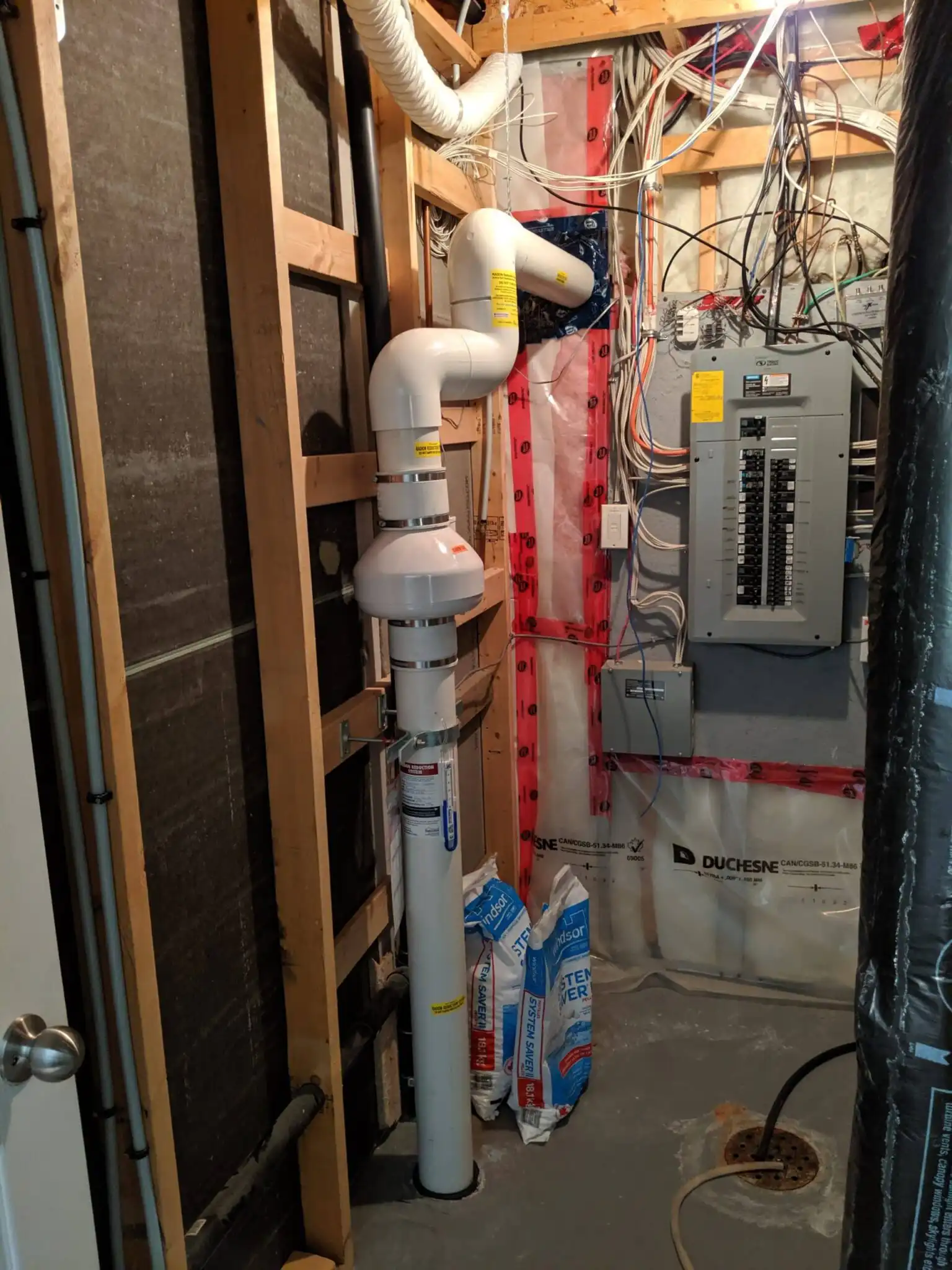
Most radon comes up from the soil under the house. A radon system, called sub-slab depressurization, draws that soil gas from under your floor through a sealed pipe, with a fan, and sends it outside before it can get in. We seal the main openings in the floor, like a sump pit, so the fan pulls from the ground and not from your house.
Install Day
Most installs take one day, and the work stays in the basement or crawlspace. In a newer Alberta home, the builder's capped radon pipe can become part of the system once we've tested it. Dust and noise: see What Happens on Install Day?
What's Under the Slab, and Why It Matters
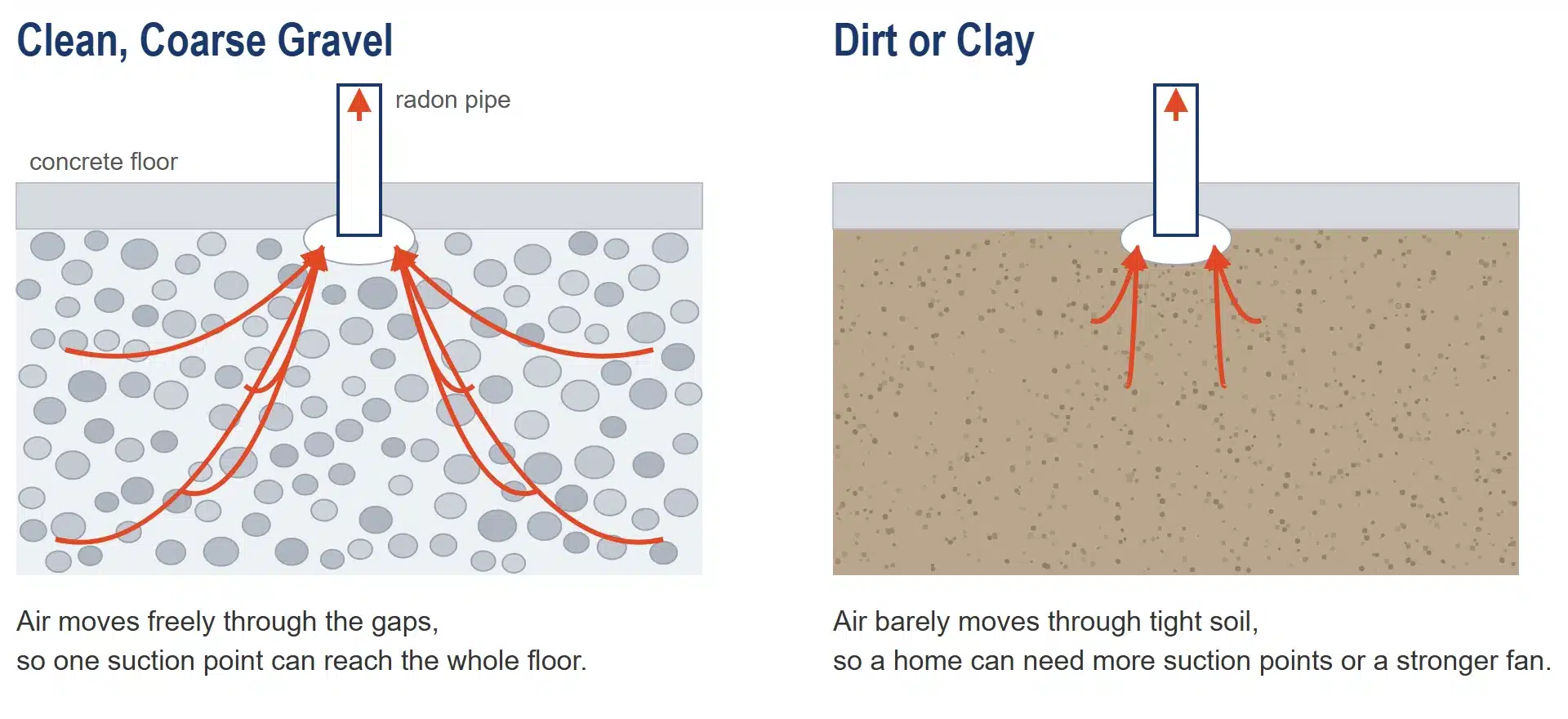
The material under your basement floor, sometimes called fill or backfill, is whatever the builder used, from clean, coarse gravel to sand, dirt or clay. A radon system draws air from under the whole floor. In clean gravel, the gaps between the stones let air move freely, so one system can reach all of it. Air moves much less easily through sand, dirt or clay, so a home on dense ground can need more than one suction point, or sometimes a stronger fan. That is why we run a pressure field test before deciding where the system goes.
What Canada's Standard Says
Canada's radon mitigation standard says a pressure field test shall be used to decide the number of suction points and the fan size (CAN/CGSB-149.12-2024). In most areas we work in, we already know what the ground is like, and the test confirms it for your house.
Where Radon Fans Are Installed in Alberta
Canada's radon mitigation standard allows a radon fan outdoors only where winters are mild: 3,999 heating degree days or fewer. Heating degree days add up how far each day's average temperature falls below 18°C over a year, so the lower the number, the milder the winter. Alberta is far too cold for that. Even in the south, the building code's climate table puts Lethbridge at 4,500 and Medicine Hat at 4,540, and Calgary is 5,000, Edmonton 5,120 and Red Deer 5,550 (CAN/CGSB-149.12-2024, section 5.8.1.1; National Building Code 2020, Appendix C). So your fan is installed in a heated space, usually the basement, a utility room or a heated garage, where it lasts longer and stays quiet. The same standard warns that a fan outdoors in the cold can ice up (Annex E).
Radon Levels After Mitigation
What to Expect, and How Fast
Each system is designed for the house it goes in. Canada's national standard for radon mitigation (CAN/CGSB-149.12-2024, section 1) says a system that is properly designed and installed by certified professionals can lower radon by about 90% or more. How well a system works comes down to who designs and installs it. We've lowered the radon in every home and commercial building we've ever worked on. Every system we install comes with guaranteed results.
Once the fan is running, the radon under your floor is drawn outside. In our experience, the level in the house usually drops within a day or two. It never reaches zero, because outdoor air has some radon in it too. Our goal is the lowest level your home can reasonably reach.
After every install, two lab tests show you the result: a short test once the system is running, and a long-term test after that. The lab sends the results straight to you.
Tricky homes are the ones our technicians enjoy most. Even after more than 3,000 homes, we still run into something new now and then, and when we do, the whole team works on it together, so every job has the experience of all our crews across Alberta and BC behind it.

Have a result over 200 Bq/m³, or not sure what yours means? Call us and we'll talk it through.
How Long Does a Radon System Last?
The pipe and the sealing are there for the life of the house. The fan is the only moving part, and it runs all the time. When a fan wears out after years of running, it is replaced, and the rest of the system stays as it is.
Upkeep is close to none. Every system has a pressure gauge on the pipe, usually a U-tube manometer: when the fan is running, the liquid in the two sides sits at different heights. Glance at it now and then. If the two sides are level, the fan has stopped, so call us.
When to Test Again
- Every 5 years with a system running: Health Canada recommends it, to make sure the system still works as it should.
- The heating season after a renovation that changes the structure or ventilation, like finishing the basement, a new furnace or a new bathroom.
- The heating season after an energy retrofit, or digging next to the house.
Source: Health Canada's guide for radon measurements in homes (2026).
What Changes the Price of Radon Mitigation
A radon system costs a fraction of the price of air conditioning.
We've quoted thousands of homes, so a few details about yours are usually enough for an accurate quote, often over the phone.
- Your foundation: poured concrete, concrete block or wood.
- Your footprint: the part of the house that sits on the ground, not the total square footage.
- Additions, and any crawlspace with a dirt or gravel floor.
- Your neighbourhood. In most areas we work in, we already know whether the ground under the floor is gravel, sand, dirt or clay, and how dense it is. Ask us about yours.
- A sump pit, which we seal airtight.
- Whether the basement is finished.
Some things change the work but rarely the price: with in-floor heat we thermal-scan the slab before we drill, with a furnace or other fans we check how they change the pressure in your home, and an HRV may need balancing afterward.
Questions about your home? Talk to a radon expert.
Have a Builder's Radon Pipe?
Many Alberta homes the builder applied to build after November 1, 2015 have a capped radon pipe in the basement floor. We test it before using it, and when it passes, it can become part of your system. See Radon in the Alberta Building Code.
Radon Grants and Help Paying in Alberta
The Lungs Matter Grant
The Canadian Lung Association's Lungs Matter program can put up to $1,500 toward mitigation. You may qualify if:
- You have been diagnosed with lung cancer, or your household has a low to moderate income (the Alberta income limit is on their page).
- You have a long-term test of at least 90 days (about three months), using a C-NRPP listed device, showing more than 200 Bq/m³.
- You have a quote from a C-NRPP certified mitigation professional. We can provide one.
- You apply before the work is done. Funding is limited, so apply early.
At the time of writing (October 2026), there is no Alberta, regional or city grant for radon mitigation. Anything we missed? Let us know.
Other Help in Alberta
- Alberta Lung. In radon season, October to April, Alberta Lung may help people affected by lung cancer whose home tests over 200 Bq/m³. It asks for a 90-day test and an income tax statement, and its funding is limited.
- SHARP is a loan, not a grant. Alberta's Seniors Home Adaptation and Repair Program doesn't name radon, so ask whether your work qualifies before you count on it.
For the details on each, see grants and other help paying for radon mitigation.
Radon in the Alberta Building Code
What a Newer Home Has, and What It Doesn't
What a rough-in is in Alberta. A pipe at least 100 mm across, through the basement floor into a layer of clean gravel, sealed airtight with a cap and labelled so the next owner knows what it is. The code also allows a gas-permeable layer under the floor with an inlet and a labelled outlet. It gives a radon system a head start.
No fan, and no pipe to the outside. No Alberta code has ever required either. Only the rough-in is required for a house. When a full system is put in, the pipe has to end outside, at least 300 mm above the ground and at least 1.8 m from an air intake (Government of Alberta, STANDATA 14-BCI-017).
The dates go by when the builder applied to build, so a house finished in 2016 may have been built to the older code.
Newer homes around Calgary also tested higher. The University of Calgary study found homes built in 1992 or later averaged 142 Bq/m³, against 108 for older homes (CMAJ Open, 2017).
New-home warranty. The Alberta New Home Warranty Program says the presence of radon at any level is not warrantable (ANHWP). If your newer home tests high, fixing it is up to you.
For existing homes, the national standard is CAN/CGSB-149.12-2024, Radon Mitigation Options for Existing Buildings. We install every system to it.
May 1, 2015
The Alberta Building Code 2014 comes into force, with Alberta's first radon rough-in for new homes: a capped pipe through the basement floor. Builders could use either code until November 1, 2015, so the rough-in is certain for homes the builder applied to build after that date (Government of Alberta).
December 1, 2019
A new edition, the National Building Code (Alberta Edition) 2019, keeps the rough-in and asks for the pipe to be labelled, so the next owner knows what it is (Government of Alberta).
May 1, 2024
The National Building Code (Alberta Edition) 2023 carries the rough-in forward. Still no fan, and no pipe to the outside, required by code (Government of Alberta).
Newer Homes Often Test Higher
In the 2024 survey (pages 51 and 52), Alberta's average home radon level rose by 39.2 Bq/m³ with the year a home was built, over the roughly 50 years from 1971 to 2024, and homes tested within a few years of being built averaged 131.6 Bq/m³. A capped pipe doesn't keep radon out, so test a newer home too.
Radon in Child Care and Schools in Alberta
Child Care: No Rule in Alberta
Alberta passed the Radon Awareness and Testing Act in 2017. It would have required licensed child care to test for radon before a licence was issued or renewed, and to have a plan to lower it if the level was high. It was never brought into force, and it was repealed at the end of 2023 (Alberta King's Printer). So today, Alberta has no radon testing rule for child care, and we found no mention of radon in its child care law.
Next door in BC, the Interior Health region has required every licensed child care provider to test since May 2017 (Interior Health).
Schools
If you're not sure about your child's school or child care, ask whether it has been tested for radon, when, and what the result was.
Schools and other public buildings are tested to a separate Health Canada guide, the Guide for Radon Measurements in Public Buildings.
Radon When Buying or Selling a Home in Alberta
Agents must disclose a known high result. Under the Real Estate Act Rules, a seller's agent must tell every buyer about any material latent defect they know of, a defect a reasonable inspection would not find, including one that makes the home dangerous or potentially dangerous to live in (Real Estate Council of Alberta). As of August 2025, the council's own buyer guidance said that a radon result over 200 Bq/m³ is a material latent defect that must be disclosed, unless a radon system was installed before the home was listed (Ask RECA, no longer on its website).
No form asks. Unlike BC, there is no question about radon on a standard Alberta seller form. If you're buying, ask whether the home has been tested, and when.
Buying without a test? A proper test takes at least 91 days, longer than most offers stay open. A holdback is one option, or a long-term test in your first heating season after you move in (CARST real estate guideline).
Selling in the Spring?
Our advice: test the winter before you list. A long-term result you can show buyers answers the question before it's asked, and if it is high, the work can be done, and the result after it shown, before you sell.
Radon in Condos, Townhomes and Rentals
Condos and Townhomes
You can test your own unit, and if it reads over 200 Bq/m³, take the result to your condo board. Alberta's Condominium Property Act doesn't mention radon, but it makes the condo corporation responsible for the control, management and administration of the common property (section 37). So work that touches common property, like a pipe through an outside wall or the roof, goes through your board, and your corporation's own bylaws set the rules.
Our advice: in a townhome row or a building over a shared garage, test more than one unit, because the ground and the slab are shared.
Renters
Alberta's Residential Tenancies Act doesn't mention radon, but a landlord must make sure a rental meets at least the minimum housing standards under the Public Health Act (Residential Tenancies Act, section 16). Renters can test too: a long-term kit sits quietly in a room for three months. If the result is high, share it with your landlord.
Energy Retrofits and Radon
Making a home tighter is a good thing, but it can change your radon level. Health Canada says energy retrofits can reduce air exchange and may increase radon levels, and recommends testing again the heating season after new windows, insulation or sealing (Radon and energy retrofits). The same goes for a new furnace or any change to how your home is ventilated.
Planning a retrofit? Test before and after. If you already have a radon system, we can check how the new work changes the pressure in your home.
Radon at Work in Alberta
Alberta Occupational Health and Safety updated its radon bulletin in April 2026. It says OHS requirements apply where radon has been identified as a workplace hazard: like any other hazard, the employer assesses it and then eliminates or controls it. It points to the same 200 Bq/m³ guideline as for homes, recommends long-term tests of 90 days or more in winter, and recommends C-NRPP certified professionals (Alberta OHS, Radon in the Workplace).
A business, school or apartment building? We test and fix commercial buildings too. Call 1‑844‑723‑6622.
Radon in Alberta and BC: What's Different
We Work in Both Provinces
The guideline is the same, and so is an agent's duty to disclose a known high result. The differences are in the building code, child care, the seller's form and the workplace.
- Radon guideline: Alberta: 200 Bq/m³ (Health Canada). BC: 200 Bq/m³ (Health Canada).
- Radon rough-in in new homes: Alberta: Every new home applied for after November 1, 2015 (Alberta Building Code 2014). BC: In the listed places, homes applied for from December 2012, with the pipe to the outside from December 2014; every new home applied for from March 2024.
- Pipe to the outside required by code: Alberta: No: a capped pipe in the floor. BC: Yes: in the listed places for homes applied for from December 2014, and everywhere for homes applied for from March 2024.
- Fan required by code: Alberta: No. BC: No.
- Fan outdoors allowed by the standard: Alberta: Nowhere: no place in Alberta is mild enough. BC: In the milder parts of southern BC.
- Child care: Alberta: No rule. A 2017 law that would have required testing was repealed at the end of 2023. BC: Must test in the Interior Health region, since 2017.
- Seller's disclosure form: Alberta: No standard form that asks about radon. BC: Asks about radon, since April 2020 (voluntary form).
- Agent must disclose a known result over 200 Bq/m³: Alberta: Yes. BC: Yes.
- Radon in the workplace: Alberta: A 2026 Alberta OHS bulletin names radon and the 200 guideline. BC: No radon-specific rule.
- New-home warranty: Alberta: The Alberta New Home Warranty Program says radon is not warrantable. BC: The warranty law doesn't mention radon.
Sources: Government of Alberta (Alberta Building Code 2014 and the National Building Code, Alberta Edition) and STANDATA 14-BCI-017; CAN/CGSB-149.12-2024 and the National Building Code 2020, Appendix C; Alberta King's Printer; Interior Health; the Real Estate Council of Alberta; Alberta OHS bulletin RAD007 (April 2026); Alberta New Home Warranty Program. The BC side in full, with its own sources (the BC Building Code bulletins, the BC seller's form and BC's real estate rules): Radon in BC.
Radon Questions
Is Radon a Problem in Alberta?
Yes. In the 2024 Cross-Canada Survey of Radon, about 1 in 6 Alberta homes tested at or above Health Canada's guideline of 200 Bq/m³, and every Alberta city and metro area in the survey's table had more than 1 in 10. A long-term test of your own home is how you find out where yours sits.
Is There a Safe Radon Level?
No level of radon is considered risk free. Health Canada's guideline is 200 Bq/m³: above it, lower your level within a year, and sooner the higher it is (Health Canada’s guide for homes). Health Canada also says 200 is not a recommended stopping point if your home can reasonably go lower. See What Your Radon Level Means.
Does Alberta Have Its Own Radon Guideline?
No. Alberta uses Health Canada's guideline of 200 Bq/m³, the same as the rest of Canada. Alberta's workplace safety bulletin points to the same number (Alberta OHS), and no Alberta law sets a level for homes. Below 200 is not the goal either: lower is better.
Is Radon Worse in Calgary or Edmonton?
About the same. In the 2024 survey, the Edmonton metro area averaged 106.4 Bq/m³ with 16.2% of homes at or above 200, and the Calgary metro area 102.5 Bq/m³ with 15.5%. Both had the highest averages of Canada's six largest metro areas. Some smaller towns are higher: see Radon by Area in Alberta.
Is Radon Higher in Southern Alberta?
In some towns, yes. In the 2024 survey the highest shares of homes at or above 200 Bq/m³ were in towns around Calgary: Okotoks 30.4%, Strathmore 28.3% and High River 25.3%. Farther south, Lethbridge was 16.8%, close to Calgary and Edmonton, and Medicine Hat 11.1%. Every one of them has homes well over the guideline, so test yours wherever you are.
My Neighbour's Home Tested Low. Do I Still Need to Test?
Yes. Radon can be very different from one house to the next, even on the same street, because of the ground under each house and how it was built. In the University of Calgary's tests from 2013 to 2016, every quadrant of Calgary had homes at or above 200 Bq/m³ (CMAJ Open, 2017). Your own long-term test is the only way to know.
I Got a High Reading on a Library Radon Detector. What Should I Do?
Call us with the number and how many days it ran. Depending on both, it can be enough to go ahead, or we may suggest a long-term test first. If it read low, follow it with a long-term test of at least three months, because a short test cannot rule radon out.
Are Digital Radon Detectors Accurate?
The good ones are, given time. C-NRPP tests home radon monitors, and its 2024/25 report lists the Corentium Home’s stated accuracy as within about 10% after 7 days at 200 Bq/m³, and within about 5% after two months. In 2025 Health Canada warned that various radon detectors sold on Amazon.ca may give inaccurate readings, and it suggests replacing a home monitor about five years after you buy it, unless it can be recalibrated.
My Alberta Home Has a Radon Rough-In. Am I Covered?
Not necessarily. In Alberta the rough-in is a capped pipe in the basement floor: there is no fan and no pipe to the outside, so test the house first. If the result is high, we test the pipe before using it. See Radon in the Alberta Building Code.
What Happens on Install Day?
Most installs take one day. The work happens in the basement or crawlspace, so we don't need the run of the whole house. We drill with Hilti dust extractors fitted with HEPA filters, made for drilling and coring concrete, not shop vacs, so the dust is caught as we go. There is some noise while we drill through the concrete, but it comes in short bursts, and most people upstairs carry on with their day.
Why Doesn't RadonCare Offer Free Radon Tests?
Because we want the test done right. A proper test runs for at least three months in the lowest lived-in level of your home, and we only recommend a system when a test shows your home needs one. For a free first look, borrow a detector from your library, then follow up with a long-term test.
Are There Grants for Radon Mitigation in Alberta?
The main one is the Canadian Lung Association's Lungs Matter grant, for people diagnosed with lung cancer or households with a low to moderate income, and you have to apply before the work is done. Alberta Lung may help in radon season if you have been affected by lung cancer. At the time of writing (October 2026), there is no Alberta, regional or city grant for radon mitigation. Anything we missed? Let us know. See Radon Grants and Help Paying.
How Soon Does Radon Drop After a System Goes In?
In our experience, usually within a day or two of the fan starting. See Radon Levels After Mitigation.
Does a New-Home Warranty Cover Radon in Alberta?
Not from the Alberta New Home Warranty Program: it says the presence of radon at any level is not warrantable (ANHWP). The rough-in the code asks for has no fan, so test a new home in its first heating season.
Does Alberta Require a Radon Test When You Sell?
No. No Alberta law requires a test, and no standard seller form asks. But a seller's agent must disclose a material latent defect they know of, and the Real Estate Council of Alberta's buyer guidance has counted a result over 200 Bq/m³ as one. See Buying or Selling a Home.
Areas We Serve in Alberta
Our Alberta crews work across the Calgary area, central Alberta and the Edmonton area. Each of these pages has the local radon numbers, our work there, the code dates and where to borrow a detector:
We also work in Chestermere, Strathmore, High River, Black Diamond, Turner Valley, Canmore, Olds, Didsbury, Sylvan Lake, Lacombe, Beaumont, Fort Saskatchewan and Stony Plain, and across the BC Interior. Not sure about your town? Call 1‑844‑723‑6622.
Get a Free Quote or Ask a Question
Fill out the form and a radon expert will get in touch to answer your questions. Prefer to talk? Call 1‑844‑723‑6622.
About RadonCare
We've lowered the radon in every building we've ever worked on: more than 3,000 homes across Alberta and British Columbia, plus schools, apartment buildings and government buildings. We started out in heating and ventilation, so our team of C-NRPP certified professionals designs every system from how air actually moves through your house, and we aim for the lowest level your home can reasonably reach, not just under the guideline. From your first test to a system built for your home, the results are guaranteed. RadonCare is a five-time Consumer Choice Award winner, and we're involved in Canada's radon industry, with seats on the CARST board of directors and the C-NRPP advisory board.
Updated October 2026